





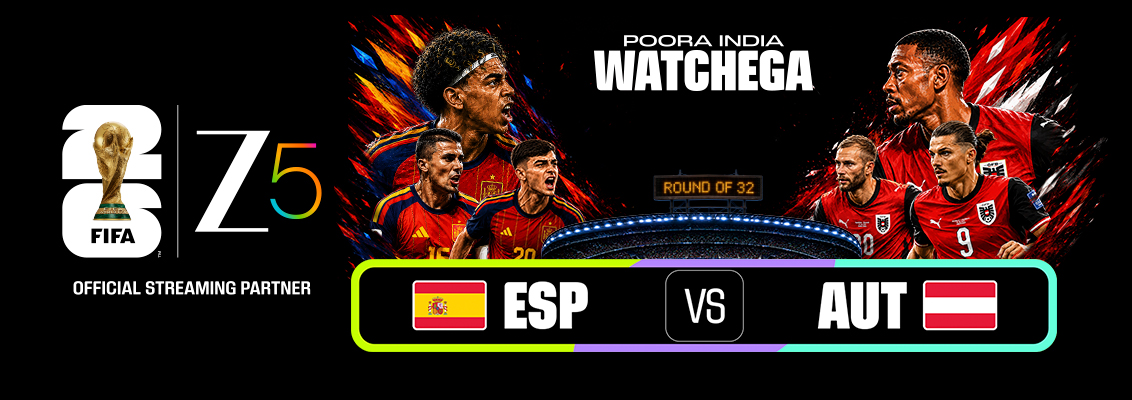
Round of 32 | Los Angeles Stadium | Thursday, 3 July — 12:30 AM IST
How They Line Up
Spain — 4-3-3
Unai Simón in goal. Pedro Porro at right-back — technically excellent and willing to carry from deep — Pau Cubarsí and Aymeric Laporte as the centre-back pairing, Marc Cucurella at left-back. Fabián Ruiz, Rodri, and Pedri in the midfield triangle: Rodri sits deepest as the single pivot and defensive anchor, while Pedri and Ruiz will advance into the half-spaces and provide combinations behind Austria’s press. Lamine Yamal from the right, Mikel Oyarzabal through the middle as the central striker, Gavi from the left. In De la Fuente’s system in possession, Porro and Cucurella push up to create a five-man attacking line, Rodri holds the midfield base, and Pedri and Ruiz provide the connections between the lines. Against a high-press system, this shape creates simultaneous decisions for Austria’s defensive block across every zone.
Austria — 4-2-3-1
Alexander Schlager in goal. Stefan Posch at right-back, David Alaba and Philipp Lienhart as the centre-back pairing — Alaba the organising presence and captain who anchors the defensive line — Phillipp Mwene at left-back. Xaver Schlager and Nicolas Seiwald as the double pivot: Seiwald provides the defensive intensity and relentless pressing energy that Rangnick’s system demands; Xaver Schlager covers the transition and distributes from deeper positions. Konrad Laimer from the right of the three, Romano Schmid in the middle — Austria’s creative engine and Marcel Sabitzer from the left. Marko Arnautovic leads the line, the focal hold-up presence who links play and brings Laimer and Sabitzer into goal-scoring positions.
Watch the FIFA World Cup 2026™ live in India on ZEE 5. Choose the ₹799 quarterly plan or the ₹1,699 annual plan to stream every match of the tournament.
The Battles That Will Decide This Match
Lamine Yamal vs Phillipp Mwene — Austria’s entire defensive preparation for Thursday will have started with one question: how do you stop Lamine Yamal? The 18-year-old curled a left-foot strike into the top corner against France in the EURO 2024 semi-final at 16. He’s scored at the Los Angeles Stadium already in this tournament, against Saudi Arabia. Mwene at left-back will face the most difficult 90 minutes of his career. The instinct is to press early and force Yamal inside, but Mwene can’t over-commit because Yamal shifts direction at full pace. If Mwene holds his position, Yamal gets the cross early. If he presses, Yamal cuts inside onto his left foot and creates from the inside channel. Austria need Schlager to double up when Spain build from the right.
Pedri vs Nicolas Seiwald — Pedri’s value in Spain’s system comes from his ability to receive the ball between Austria’s defensive and midfield lines, take one touch to set his feet, and then play forward in a single motion before the press can arrive. Seiwald’s task is to deny that first touch entirely — pressing the moment Rodri or Ruiz looks to play through the middle, tracking Pedri’s lateral movement inside the block, and preventing the combination play that opens up Spain’s transition attack. Seiwald is disciplined and physically strong; his experience in the Bundesliga with RB Leipzig gives him the pressing structure to execute this in a high-pressure match. The question is whether he can maintain the defensive intensity for 90 minutes against a player who moves as constantly and unpredictably as Pedri. If Pedri gets four or five clean touches facing forward in the first 30 minutes, Spain’s attack builds on its own.
Marcel Sabitzer vs Fabián Ruiz — Operating from Austria’s left side, Sabitzer cuts inside into the right half-space between Spain’s midfield and defensive lines — and the player responsible for tracking that movement is Fabián Ruiz, Spain’s right-sided central midfielder. Ruiz’s role in De la Fuente’s 4-3-3 is both creative and defensive: he provides right-side combinations in possession and covers the zone when Porro pushes high on the overlap. When Sabitzer drops inside from the left and looks to receive between the lines facing forward, Ruiz must press the receiving moment without being pulled so far from his position that Spain’s midfield triangle loses its shape. At 100-plus international caps, Sabitzer has the spatial awareness to exploit exactly those small windows — arriving into the half-space at the right moment, playing Arnautovic or Schmid into danger before Ruiz can engage. If Ruiz stays tight to Sabitzer’s receiving position and forces the ball back into Austria’s double pivot, the left side of Austria’s attack becomes a dead end for the evening. If Sabitzer receives on the turn in that right half-space facing Spain’s backline, Cucurella and Laporte face decisions they’d rather not have to make before the match has settled.
Marko Arnautovic vs Pau Cubarsí & Aymeric Laporte — At 37, Arnautovic doesn’t run in behind. His value is entirely about arriving in the pocket between Spain’s defensive line and Rodri’s pivot — receiving under shoulder-to-shoulder pressure, spinning or laying off, and creating the second chance for Laimer or Sabitzer arriving from deep. Laporte has the experience and reading of the game to track Arnautovic’s movement and deny the receiving position before it develops. Cubarsí is the one Austria will test more aggressively — setting physical screens on corners, pressing him early in his distribution, and creating moments where the young centre-back makes a decision under pressure. If Cubarsí is composed and Laporte communicates well with the defensive line, Arnautovic becomes isolated. If Austria can isolate Cubarsí in a physical aerial duel and win it, Rangnick’s side get the kind of set-piece and second-ball chances their system is built to finish from.
Tactical Breakdown
Spain’s possession structure puts Austria’s press under immediate pressure. When Rodri receives centrally, and Porro pushes high on the right, Austria must decide: does Schmid step up and press Porro, or does he hold? If Schmid steps, Cucurella has a free run on the opposite side and Gavi receives without pressure. If Schmid holds, Spain recycle and shift quickly, and the press will become positional rather than effective. De la Fuente’s system is designed to force exactly these decisions in every passing sequence — pressing a team that presses back means the team that retains more composure under that sustained pressure controls the match.
Rangnick’s counter is to win the first ball in Spain’s half and release quickly. Seiwald and Xaver Schlager maintain their defensive shape when Spain have possession but press the moment Rodri or Ruiz turns away from goal — the trigger point for Austria’s press is any Spain player turning away from goal. When Austria win the ball high, the first pass goes to Arnautovic as the hold-up point, Laimer arrives from the right, Sabitzer drops a yard to link play, and the transition is delivered before Spain’s Pedri and Ruiz can recover their defensive positions. Whether it works against Spain’s press recovery is the match-defining question.
The Decisive Factor
Spain’s midfield triangle has to maintain its defensive shape during Austria’s transition phase — specifically, whether Pedri and Ruiz recover their positions quickly enough after Spain lose possession to close Sabitzer’s receiving zone before Arnautovic can lay off. Spain dominate this match in possession and in quality. But De la Fuente’s 4-3-3 historically leaves the space between the defensive line and the midfield open in the ten seconds after a turnover — and that is precisely where Austria’s counter-press is designed to operate. Pedri and Ruiz have to track back and deny space to Sabitzer and Schmid. If Austria get three or four clean transition sequences in the first half and Sabitzer delivers one of them to Arnautovic or Laimer in a position to finish, Los Angeles becomes a different match entirely.
ZEE 5 is the official streaming home for the FIFA World Cup 2026™ in India. Spain vs Austria kicks off at 12:30 AM IST on 3 July — check available ZEE5 FIFA 5 subscription plans and stream the match live.
Disclaimer: Subscription pack prices are subject to change from time to time. Please visit the subscription page for the most up-to-date pricing information.