





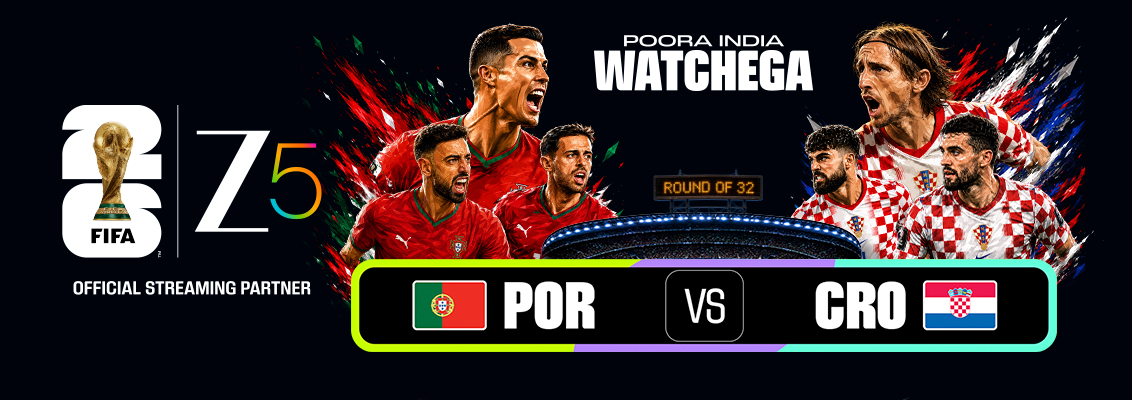
Round of 32 | BMO Field, Toronto | Thursday, 3 July — 4:30 AM IST
How They Line Up
Portugal — 4-2-3-1
Diogo Costa in goal. João Cancelo at right-back, Rúben Dias and Renato Veiga as the centre-back pairing — Dias the experienced organiser who dictated Portugal’s defensive line across the last two group games, Veiga the composed left-sided centre-back who played in all three matches. Nuno Mendes at left-back, one of Portugal’s most important attacking outlets — his overlapping runs from the left side and his delivery from wide positions are a constant creative weapon that Croatia must account for. João Neves and Vitinha in the double pivot: Neves the more aggressive presser and ball-winner, Vitinha the technical carrier who recycles possession and links play from deep. Pedro Neto from the right of the three, Bruno Fernandes at ten as Portugal’s creative conductor, João Félix from the left. Cristiano Ronaldo leads the line — 145 international goals, ten FIFA World Cup goals, and at 41 the most decorated scorer in the history of the international game.
Croatia — 4-2-3-1
Dominik Livaković in goal. Josip Stanišić at right-back — the Bayern Munich full-back whose cross in the 54th minute against Panama created Budimir’s winner — Ivan Sutalo and Josip Pongračić as the centre-back pairing, Joško Gvardiol at left-back. At 24, Gvardiol is one of the finest defenders in world football — his transformation from raw wing-back to elite centre-back at Manchester City was complete before this tournament. Playing at left-back in Toronto, he is Croatia’s most important defensive figure and the player Martínez’s side must find a way past. Mateo Kovačić and Luka Modrić in the double pivot: Kovačić the pressing engine who covers ground and disrupts transitions, Modrić the 40-year-old conductor who changes Croatia’s tempo and distributes at a precision nobody else in this squad can replicate. Josip Baturina from the left, Luka Sučić at ten, Nikola Vlasić from the right. Ivan Perišić provides an experienced attacking option from the bench or left side if Dalić adjusts. Andrej Musa leads the line — direct, quick, a threat in behind the defensive line.
Watch the FIFA World Cup 2026™ live in India on ZEE 5. Choose the ₹799 quarterly plan or the ₹1,699 annual plan to stream every match of the tournament.
The Battles That Will Decide This Match
Josip Baturina vs João Cancelo — Croatia’s most dangerous attacking player will spend Thursday morning targeting Portugal’s right-back position. Baturina — 21 years old, quick, and capable of arriving into the box from deep or exploiting space behind a high-set fullback — scored against England from exactly the position Dalić will have designed for him again here. Cancelo at right-back has the technical quality and forward instinct that make him one of the finest attacking fullbacks of his generation, but his commitment to advancing leaves space behind whenever Croatia wins possession. Baturina’s game is built for that space: he drops deep, receives with his back to goal, spins, and accelerates before the defensive line can recover. Every time Cancelo pushes high in Portugal’s attacking sequences, he must calculate the risk of losing the ball and the ground he needs to cover to deal with Baturina in behind. If Croatia catches him out of position and switches quickly to Baturina, the corridor is open.
Bruno Fernandes vs Mateo Kovačić — Portugal’s creative axis pushes from the ten position to receive the ball between Croatia’s defensive and midfield lines — and that is exactly the space Kovačić is tasked with eliminating. His job in the double pivot with Modrić is to let the older player control the ball and set the tempo, while Kovačić handles the pressing transitions, tracking Fernandes’s movement and denying him the half-turn that makes him dangerous. Fernandes at his best receives with one touch, plays forward in a single movement, and already knows where Neto or Félix is making the run. Kovačić’s ability to anticipate where Fernandes wants to position himself and arrive before the ball does is the key defensive challenge of Thursday. If Fernandes keeps receiving touches in the first half-hour, Portugal’s attack organises itself. If Kovačić tracks his dropping runs closely enough, Fernandes has to find alternative routes, and Portugal has to slow down.
João Neves vs Luka Modrić — Modrić at 40 is Croatia’s most important player and their most important tactical problem for Portugal. He does not run in behind. He does not depend on pace or physical dominance. His ability to receive the ball with some space and deliver it at a tempo and with an accuracy that changes what Croatia’s runners can do separates him from other midfielders. Neves is the player Martínez will ask to press that receiving moment — to arrive before Modrić can settle, force the touch backwards, and prevent Croatia’s tempo-setting from beginning in the first place. Neves at 20-something is still aggressive and direct in his pressing; Modrić at 40 has spent two decades reading the pressing trigger and finding the pass to beat it. There are stretches in every Croatia game where the ball moves through Modrić at a rhythm no other player in this squad can produce. Portugal need to ensure those stretches are short — and Neves’s positioning and his ability to intercept the first pass into Modrić’s feet is the most direct way to achieve that.
Cristiano Ronaldo vs Sutalo & Pongračić — At 41, Ronaldo’s game is no longer built on acceleration in behind. His value is in his movement in the box — the timing of his runs across defenders, the set-piece presence, the physicality in aerial duels, and the finishing quality that has made him the highest scorer in international football history. Sutalo and Pongračić have the pace and organisation to deal with direct runners in behind, but Ronaldo creates his danger differently: arriving from a standing start into a cross, reading the ball’s flight before the centre-back can react, and finishing from positions most strikers don’t reach. Croatia’s vulnerability is not his speed but his experience. If Mendes or Cancelo delivers from wide and Ronaldo’s run times itself perfectly between Sutalo and Pongračić, the Croatian backline faces a problem no amount of defensive shape can fully eliminate. Two goals against Uzbekistan. Ten total in FIFA World Cups. The record is still being written.
Tactical Breakdown
Portugal’s 4-2-3-1 morphs into a 2-3-5 shape in possession. Dias and Veiga hold deep; Neves and Vitinha sit as the double pivot behind the attack; Cancelo and Mendes push into wide attacking positions alongside Neto, Fernandes, and Félix, creating a five-player attacking structure that pins Croatia’s backline deep and wide simultaneously. The design forces Croatia’s four defenders into one-on-one situations in wide channels and creates space in the central zone for Fernandes to operate between the lines. When Portugal build through Vitinha from deep, Croatia’s 4-2-3-1 block must decide whether Kovačić presses or holds — pressing leaves Modrić without cover, holding gives Vitinha the carry forward into the next zone.
Croatia’s defensive 4-2-3-1 compresses centrally, absorbs Portugal’s possession, and transitions quickly when the ball is won. Baturina’s role on the left side is to stay positioned in behind Cancelo’s advanced position — the moment Portugal lose possession high up the pitch, Modrić plays the switch ball, and Baturina attacks the channel before the defensive cover can recover. Croatia’s counter-attacking structure produced both goals against England and the winning move against Panama. The first pass out of defensive possession is fast and direct; Musa’s runs in behind the last defender are the forward target. Portugal’s double pivot must track that first ball immediately — if Neves or Vitinha is slow to recover their defensive position after a turnover, Croatia’s transition sequence reaches Musa or Baturina in space.
ZEE 5 is the official streaming home for the FIFA World Cup 2026™ in India. Portugal vs Croatia kicks off at 4:30 AM IST on 3 July — check available ZEE5 FIFA 5 subscription plans and stream the match live.
Disclaimer: Subscription pack prices are subject to change from time to time. Please visit the subscription page for the most up-to-date pricing information.


