




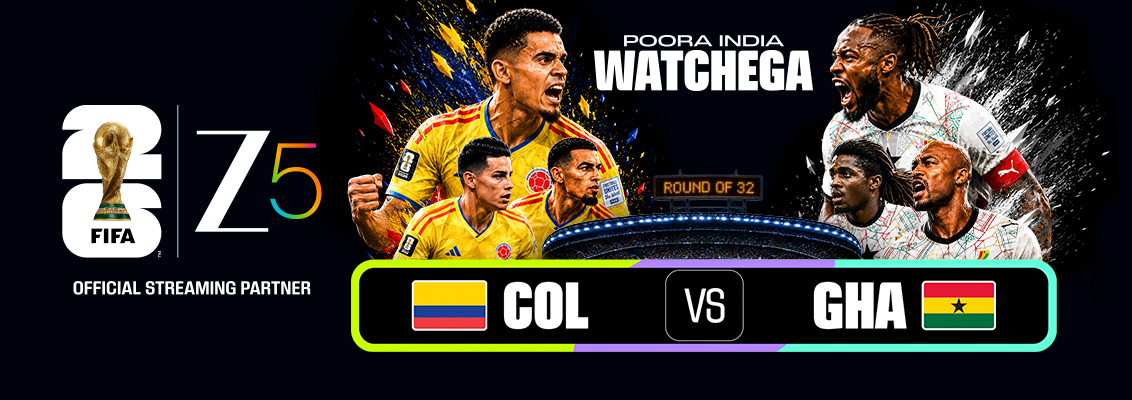
Round of 32 | Kansas City | Saturday, 4 July — 7:00 AM IST
How They Line Up
Colombia — 4-3-3
Camilo Vargas in goal. Muñoz at right-back — one of the most productive full-backs in the group stage, contributing at both ends across Colombia’s opening two wins. Davinson Sánchez and Jhon Lucumí as the central defensive pair, each comfortable on the ball when Lorenzo’s system builds from the back. Mojica at left-back, providing the width on Colombia’s left when Díaz drifts inside. Jefferson Lerma anchors the midfield — the deepest of the three, covering the ground between the back four and the central zone, winning second balls and making it difficult for pressing teams to find rhythm through the middle. Arias and Gustavo Puerta on either side: Puerta’s technical quality in tight spaces, Arias’s vertical runs from deep. James Rodríguez at the top of the midfield triangle, operating between the lines — receiving, slowing the game when Colombia need it, and delivering the diagonal or the through ball before Ghana’s defensive block can set. Luis Díaz from the left, Suárez through the middle, and Rodríguez completing a front three that presses high and transitions at pace when Colombia win the ball in Ghana’s half.
Ghana — 4-1-4-1
The goalkeeper switch from Lawrence Zigi to Asare came for Ghana’s second group game and held for the third — Asare between the sticks for the draw with England and the defeat to Croatia. Mensah at left-back, Opoku and Adjetey as the central defensive pairing, Senaya at right-back. Thomas Partey sits as the single pivot between defence and the midfield four — the player Queiroz’s defensive shape is built around, the anchor who compresses the central corridor and disrupts the opponent’s build-up before it reaches the dangerous zone. Sulemana from the left of the midfield four, Sibo and Owusu as the central two. Semenyo has played from the left and the right — the widest of the four midfielders when Ghana defend, with the most licence to push forward when Ghana have the ball and space opens in the transition. Jordan Ayew leads the line alone as captain, the hold-up target and pressing trigger, giving the midfield block time to reorganise when Ghana win possession and look to transition.
Watch the FIFA World Cup 2026™ live in India on ZEE 5. Choose the ₹799 quarterly plan or the ₹1,699 annual plan to stream every match of the tournament.
The Battles That Will Decide This Match
Thomas Partey vs James Rodríguez — the pivot duel that defines the middle third — Partey’s role in Ghana’s 4-1-4-1 will be specific: sit between the lines, close the passing lane into Rodríguez before the ball arrives, and force Colombia to go wide or backwards rather than through. Rodríguez’s pace is not what it was in Brazil in 2014 — but his reading of the game, his ability to find the pocket between Partey and the midfield four, is still very precise. The quality of what he delivers in that half-second of space remains dangerous.
Luis Díaz vs Senaya— the left flank duel Colombia’s attack is built to exploit — Díaz operates from Colombia’s left wing in Lorenzo’s 4-3-3, which puts him directly against Ghana’s right-back Senaya for most of the 90 minutes. Senaya has been one of Ghana’s more consistent performers in the group stage. But Díaz is a different proposition. He plays for Bayern Munich, scored and assisted in Colombia’s opening match, and creates chances equally from crossing positions wide and from cutting inside onto his right foot. The specific danger comes when Mojica — Colombia’s left-back — stays narrow and Díaz receives the ball in the wide channel with Senaya as his only defender. That switch, arriving at pace before Senaya can close the gap, is the sequence Queiroz will spend most of this week trying to shut down.
Tactical Breakdown
Lorenzo’s 4-3-3 presses high and is built to win the ball in Ghana’s half. The front three — Díaz, Suárez, and Rodríguez — have defined pressing triggers: Suárez cuts off Partey’s receiving angle from the back four; Díaz engages Senaya immediately when Ghana try to play out from defence; Rodríguez positions himself to prevent Sibo or Owusu from receiving in the half-space where they could play forward. When the press works — when Ghana are forced to play long, and Colombia win the second ball — Lorenzo’s side transition quickly: Díaz runs behind the defensive line before Ghana’s midfield can recover, Rodríguez plays the early forward pass, and Colombia arrive in numbers before Ghana’s defensive structure can reset. The three goals against Uzbekistan came primarily from that transition sequence.
Queiroz’s 4-1-4-1 accepts that Colombia will have the ball. The plan is not to press high but to sit in a compact mid-block — Partey screening the pivot zone, the midfield four holding their shape, and the defensive four staying compact enough to prevent Díaz or Suárez from receiving in central positions between the lines. When Ghana win the ball, the first pass goes forward immediately to Ayew — not because Ayew can consistently hold up against Sánchez and Lucumí, but because keeping the ball away from Colombia’s press and getting it past Lerma’s covering range is the first priority. From those transition moments, Semenyo and Sulemana push wide of Colombia’s recovering full-backs, and Ghana look for the direct ball in behind before Colombia’s back four can establish their line.
ZEE 5 is the official streaming home for the FIFA World Cup 2026™ in India. Colombia vs Ghana kicks off at 7:00 AM IST on 4 July — check available ZEE 5 FIFA subscription plans and stream the match live.
Disclaimer: Subscription pack prices are subject to change from time to time. Please visit the subscription page for the most up-to-date pricing information.


