





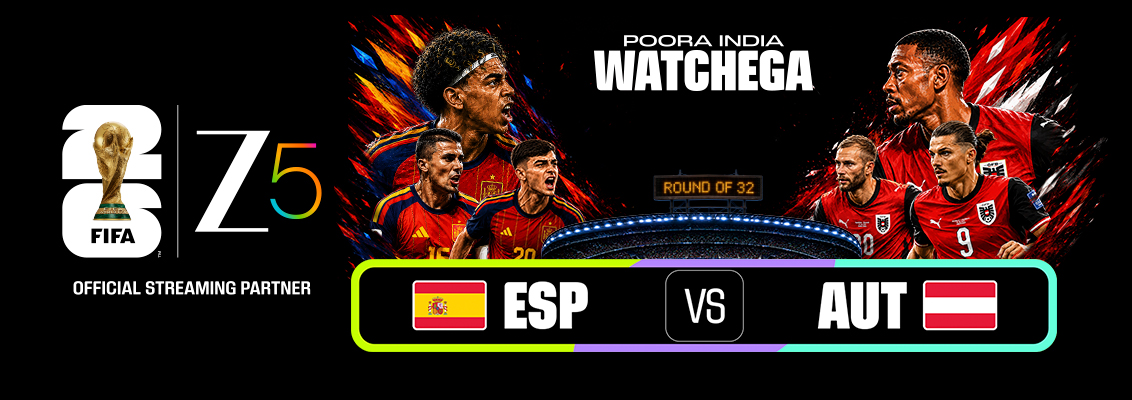
Round of 32 | Los Angeles Stadium | Thursday, 3 July — 12:30 AM IST
Match Overview
Spain arrivedarrive at the knockout stage as one of the tournament’s two or three genuine title contenders. European champions. Seven games, seven wins, and a 2-1 final over England at EURO 2024. Their group campaign had a stuttering start — a goalless draw against Cape Verde in Atlanta when Lamine Yamal did not start with a hamstring injury — and then the 4-0 against Saudi Arabia that answered every question about what this team can produce when it functions. By the time Uruguay arrived in Guadalajara, Spain were already qualified and focused on winning the group. They enter Los Angeles as the most complete squad in this section of the draw.
Austria have no business being at a FIFA World Cup 2026™ knockout match, by any pre-tournament expectation. And yet here they are. Ralf Rangnick’s side beat Jordan, pushed Argentina harder than anyone anticipated in Dallas, and qualified as Group J runners-up after navigating Algeria on the final matchday. Three years of Rangnick’s pressing system — relentless, disciplined, physically demanding — has delivered Austria their first World Cup knockout stage since 1982. They are the underdogs on Thursday. They’ve been that at every stage of this journey.
Watch the FIFA World Cup 2026™ live in India on ZEE 5. Choose the ₹799 quarterly plan or the ₹1,699 annual plan to stream every match of the tournament.
Team Analysis
Spain
Luis de la Fuente built Spain’s EURO 2024 triumph on three things: Rodri’s authority as the midfield organiser, Pedri’s creativity between the lines, and the pace and directness of Lamine Yamal and Nico Williams from wide positions. The pressing system starts from Oyarzabal at the top and runs through every line — when it works, opponents can’t build from the back without conceding possession. The 4-0 against Saudi Arabia was the closest to a complete 90-minute performance Spain have produced at this tournament: Yamal scored within ten minutes, Oyarzabal added two more before half-time, and the game was over as a contest. There are no Real Madrid players in this squad — a remarkable fact for a Spanish team in the modern era — but the Barcelona and La Liga contingent De la Fuente assembled has won a European Championship and is now competing for a World Cup.
Key Player: Lamine Yamal — He was 16 when he curled a left-foot strike past Maignan in the EURO 2024 semi-final against France — one of the greatest goals ever scored by a teenager in a major tournament. At 18, he’s improved. Faster, more decisive, and already carrying a level of defensive attention that would suffocate most wide players. Austria will have a plan for him.
Austria
Rangnick’s 4-2-3-1 is designed to press high, win possession in the opponent’s half, and attack before the defence can recover its shape. Konrad Laimer and Nicolas Seiwald form the midfield engine — both physical, both relentless in the press, both capable of covering enormous ground in transition. Marcel Sabitzer operates behind Arnautovic, finding the pockets between Spain’s lines and providing the technical quality to play through pressure when Austria have possession. David Alaba leads the defence with Champions League experience and the composure to organise under sustained pressure. Austria scored three against Jordan, held Argentina closer than most, and came through their Algeria encounter with enough resilience to reach Los Angeles. None of this was meant to happen, and none of it is accidental.
Key Player: Marcel Sabitzer — At 100-plus international caps, Sabitzer is the most experienced outfield player in Rangnick’s system and the man whose technical quality allows Austria to play through pressure rather than just over it. He presses, he carries, and he arrives late into the box from deep positions. Against Spain’s midfield — Rodri, Pedri, and Fabián Ruiz — he needs to find space without the ball and be decisive when he receives it. If he does, Austria are dangerous. If Spain’s press denies him time and rhythm, Austria’s attack becomes too direct and too predictable.
Head-to-Head Record
Spain and Austria have met in qualifying and European competition over the years, with Spain holding the stronger record in recent encounters. Their most notable World Cup meeting came in 1978 — Austria won 2-1 in a group-stage game — but context matters: both Spanish football and world football have changed significantly since then. EURO 2024 saw Austria reach the Round of 16 while Spain lifted the trophy. The quality gap between these two sides in the current era is real, and Thursday’s match in Los Angeles is the first time they meet in a World Cup knockout stage.
Prediction and Verdict
Austria’s pressing system is the one tool in this matchup that can genuinely disrupt Spain’s rhythm. If Laimer and Seiwald win possession in Spain’s half in the opening quarter, and if Sabitzer can find Arnautovic quickly before Rodri’s cover can reset, Austria create something. Rangnick will have prepared a specific press trigger for Rodri — the moment he receives deep and faces the play, that’s when Austria spring.
But Spain under De la Fuente have been playing through high-press systems since EURO 2024. Rodri’s ability to receive under pressure and release Pedri, the diagonal switches to Yamal and Williams, and the pace of those wide players on the counter are exactly the qualities that leave a high-press team exposed when it doesn’t win the ball. Austria can unsettle Spain for a period. Spain are built to answer that pressure with quality.
Spain 2-0. Yamal in the first half, and the margin could be more.
ZEE 5 is the official streaming home for the FIFA World Cup 2026™ in India. Spain vs Austria kicks off at 12:30 AM IST on 3 July — check available ZEE5 FIFA 5 subscription plans and stream the match live.
Disclaimer: Subscription pack prices are subject to change from time to time. Please visit the subscription page for the most up-to-date pricing information.