





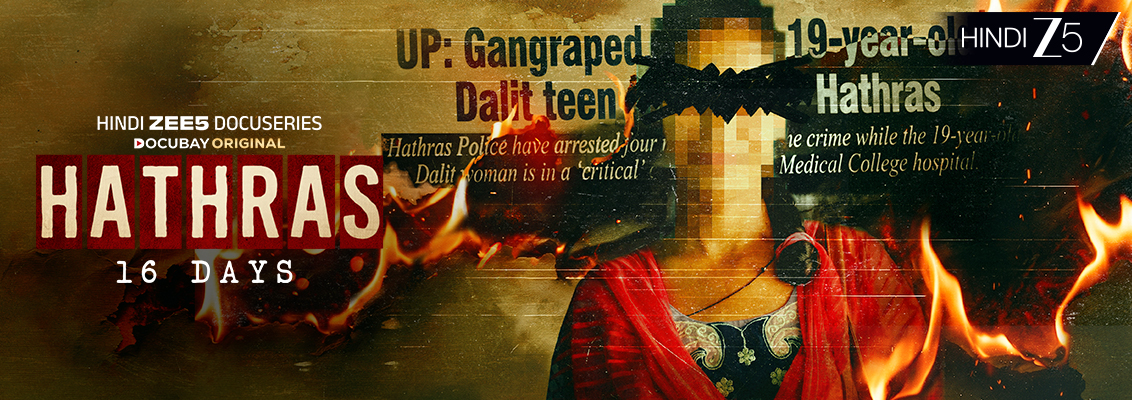
The truth does not disappear overnight. It gets buried slowly, statement by statement, headline by headline, debate by debate, until people no longer know what to believe.
That uneasy feeling sits at the centre of the Hathras 16 Days Case.
The ZEE5 documentary series on Hathras revisits one of India’s tragedies.
Hathras 16 Days is a dramatised investigative series inspired by public discussions and media reports surrounding the 2020 Hathras case. Certain scenes and characters have been recreated for storytelling purposes.
Over sixteen days, the case transformed from a horrific crime into a nationwide battle over narratives, media coverage and public trust. Every day brought fresh outrage, contradictory claims and emotional television debates that blurred the line between investigation and spectacle.
Now, this powerful crime documentary attempts to revisit those unanswered doubts with a sharper perspective and emotional honesty.
More than a standard criminal documentary, Hathras 16 Days Case becomes an examination of how sensitive stories can be fragmented, politicised, and possibly suppressed in modern India.
What does the Hathras 16 Days Case involve?
Hathras 16 Days Case traces the events that unfolded after the brutal assault of a young Dalit woman in Uttar Pradesh in 2020.
But rather than focusing only on the crime itself, the OTT documentary investigates the sixteen days that followed:
- The hospitalisation,
- The public outrage,
- The political reactions,
- The media frenzy,
- And the controversial late-night cremation that shocked the nation.
The documentary repeatedly explores how official narratives shifted during those days and why public distrust escalated so rapidly.
Actress Anjali Sivaraman portrays the journalist inspired by Tanushree Pandey, whose investigation drives much of the series forward. Through her character, viewers see how reporters who try to uncover the facts often trap themselves in the political and emotional chaos surrounding the story.
Galti Ya Saazish? Why the Debate Still Continues
One of the reasons the Hathras 16 Days Case still feels emotionally unresolved is that people continue to disagree about exactly what happened behind the scenes.
Were authorities overwhelmed by a rapidly escalating crisis?
Or were efforts made to control how the story was perceived nationally?
The thriller docuseries refuses to simplify those questions.
Instead, it examines how sensitive stories in India can become vulnerable to narrative management once political pressure, media attention and institutional reputation collide. Through recreated moments, newsroom sequences and investigative storytelling, the documentary explores how public confusion intensified during every stage of the controversy.
Veteran actor Kumud Mishra portrays a senior administrative figure navigating institutional pressure as outrage grows across the country. His performance captures the moral ambiguity of systems attempting simultaneously to maintain order and defend credibility.
How Media Narratives Shaped the Hathras 16 Days Case
The Hathras documentary series spends significant time examining how media coverage influenced public perception.
Television channels framed the case differently depending on political positioning. Social media simultaneously amplified anger, misinformation, and speculation. Every official statement became headline material within minutes.
In the series, Pavail Gulati plays a media professional struggling to balance journalism with the increasingly performative nature of breaking news culture. His role reflects how modern media ecosystems often reward speed and outrage more than careful investigation.
This layered portrayal helps the crime documentary feel especially relevant today, when audiences increasingly question whether they are receiving truth or curated narratives.
Why Sensitive Stories Often Feel Suppressed in India
The Hathras 16 Days Case taps into a broader public anxiety that extends beyond a single tragedy.
Many viewers connected emotionally with the case because it represented broader fears surrounding institutional accountability, media manipulation, political interference, caste inequality, and public distrust of official statements.
The documentary shows how sensitive stories sometimes get buried beneath endless debates, selective narratives, and competing agendas until clarity itself becomes difficult to recognise.
That theme is what elevates the series beyond a conventional crime documentary. It becomes a reflection on information, power and public memory in contemporary India.
The Emotional Core Behind the Investigation
Despite its institutional and political themes, the OTT documentary never loses sight of the emotional devastation at the centre of the case.
The recreated family sequences are restrained, intimate and deeply painful. Rather than sensationalising trauma, the series focuses on grief, helplessness and dignity denied.
Anjali Sivaraman’s portrayal of the investigative journalist becomes especially powerful in these moments, showing the emotional toll of reporting stories in which truth itself feels unstable.
At the same time, Pavail Gulati’s character reveals how prolonged exposure to an outrage-driven media culture affects journalists psychologically and professionally.
Together, these performances ensure the thriller docuseries remain emotionally grounded even as they tackle larger social and political questions.
Why Audiences Are Calling It One of the Best Documentaries on OTT
Streaming audiences are increasingly gravitating towards investigative storytelling that feels socially urgent rather than merely entertaining.
That shift explains why the best documentaries on OTT discussions now frequently involve politically and emotionally layered stories, like the Hathras 16 Days Case.
The series does not aim for comfortable closure. Instead, it forces viewers to confront difficult questions:
Can truth survive public spectacle?
Who controls national narratives during crises?
And why do some stories continue feeling incomplete years later?
That emotional and intellectual tension is precisely why the documentary continues generating strong reactions online.
The Legacy of Hathras 16 Days Case
The Hathras 16 Days Case remains significant because it exposed how fragile public trust can become when institutions, politics, and media narratives collide publicly.
The ZEE5 crime documentary revisits those sixteen days not only to reconstruct events but also to explore how societies process outrage, grief and uncertainty in the digital age.
And perhaps most importantly, it reminds audiences that sometimes the loudest silence is the one left after the headlines fade.
Where to Watch the Hathras 16 Days Case
Hathras 16 Days Case is streaming exclusively on ZEE5.
If you are interested in investigative storytelling, emotionally intense thriller docuseries and socially relevant crime documentaries, this series is among the most compelling titles currently available on streaming platforms.
Subscribe to ZEE5 today to watch Hathras 16 Days Case and discover more of the best documentaries on OTT, including gripping original series, investigative films, and true-story-inspired content.
FAQs
What does the Hathras 16 Days Case reveal about media and institutional narratives?
The Hathras 16 Days Case explores how narratives surrounding sensitive incidents can shift rapidly under political pressure, media debates, and institutional responses. The documentary examines how public trust becomes fragile when multiple versions of the same story compete for attention.
Is the Hathras 16 Days Case based entirely on true events?
Yes, the Hathras documentary series draws inspiration from the real 2020 Hathras case and the events that unfolded during the following sixteen days. While some scenes recreate dramatic storytelling, the series draws heavily from documented reports, investigations, and media coverage.
Why are viewers drawn to thriller docuseries based on real cases?
Audiences connect strongly with thriller docuseries because real events feel emotionally immediate and socially relevant. Unlike fictional dramas, investigative OTT documentaries allow viewers to engage with unresolved questions, institutional complexities, and real human experiences that continue to affect society beyond the screen.