





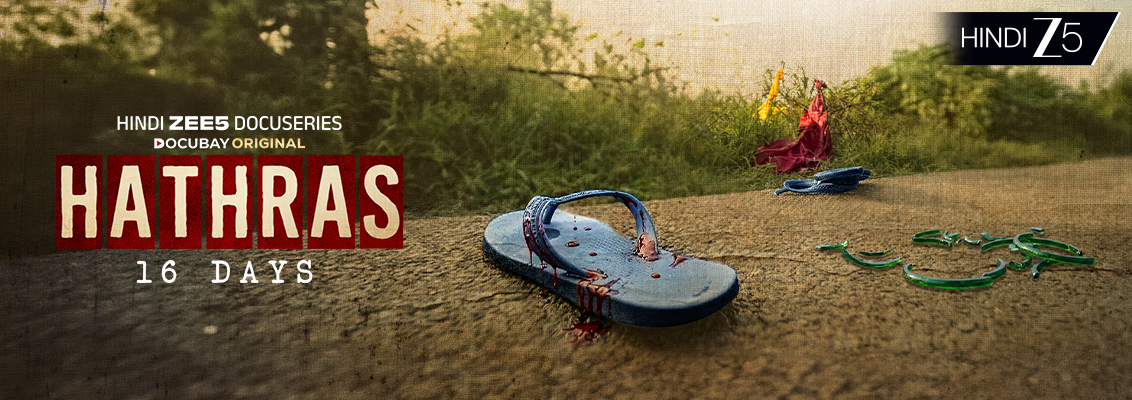
There was a moment during the Hathras 16 Days Case when millions of people across the country stopped asking only what happened and started asking whether they were being told the complete truth at all.
That shift changed everything.
The case was no longer just about one horrific crime. It became about conflicting statements, public confusion, media debates and a growing sense that official narratives themselves were becoming impossible to trust completely. Every update raised fresh questions. Every explanation seemed to create another layer of doubt.
Years later, that distrust still lingers.
Now, ZEE5’s Hathras documentary series revisits those sixteen turbulent days through a powerful crime documentary that explores how public faith in institutions, the media, and official communication began to fracture in real time.
More than a conventional criminal documentary, Hathras 16 Days Case becomes an investigation into modern distrust itself, how it grows, how it spreads and why some stories continue feeling unresolved long after headlines disappear.
How the Hathras 16 Days Case Changed Public Trust
The Hathras 16 Days Case became nationally significant not only because of the brutality of the crime but also because of the uncertainty that followed afterwards.
As the investigation unfolded, conflicting narratives emerged rapidly. Public statements shifted. Television debates intensified. Social media simultaneously amplified speculation, outrage, and political interpretation.
Many viewers watching the controversy unfold began feeling that truth itself was becoming fragmented.
The ZEE5 OTT documentary revisits this atmosphere of confusion and emotional instability, exploring how public trust weakened with every contradiction and unanswered question.
Rather than presenting simple conclusions, the thriller docuseries examines how institutional communication can sometimes unintentionally deepen public suspicion during moments of national crisis.
Why Official Narratives Began Facing Public Distrust
One of the central themes explored in the Hathras 16 Days Case is the growing gap between institutional statements and public belief.
The documentary repeatedly asks the following:
- What happens when people stop trusting official explanations?
- Why do conflicting narratives create emotional instability?
- And how does public confidence collapse once doubt enters the conversation?
Actress Anjali Sivaraman, portraying the journalist inspired by Tanushree Pandey, becomes central to these questions. Through her investigative reporting, the crime documentary explores the emotional and professional difficulties of pursuing the truth while institutions, political voices, and media ecosystems compete to shape public perception.
Her performance captures the growing frustration of journalists trying to separate truth from noise amid emotionally charged national controversies.
How Media Culture Intensified the Hathras Debate
The Hathras documentary series also examines how modern media culture contributed to rising distrust.
Television debates quickly transformed into nightly battlegrounds. Every development became politicised. Social media platforms amplified both outrage and misinformation, making it increasingly difficult for audiences to identify reliable information.
In the series, Pavail Gulati portrays a media professional trapped in the relentless pace of breaking news television. His character reflects how journalism today often exists under pressure to deliver instant narratives before complete clarity emerges.
The criminal documentary does not blame the media alone. Instead, it explores how modern information ecosystems, institutions, politics, television, and social media together created an atmosphere in which public confidence became deeply fragile.
Why Hathras 16 Days Feel So Relevant Today
The themes explored in the Hathras 16 Days Case extend far beyond one incident.
Today, audiences worldwide increasingly question institutions, governments, media organisations and official statements. Public trust feels more unstable than ever, especially during emotionally sensitive national controversies.
That is precisely why the OTT documentary resonates so strongly with viewers today.
Veteran actor Kumud Mishra portrays a senior administrative figure who attempts to manage institutional pressure as public scrutiny intensifies nationwide. His role reflects the tension between maintaining authority and preserving public trust during crises.
The documentary suggests that once people begin doubting institutional transparency, restoring confidence becomes extremely difficult.
How the Thriller Docuseries Balances Emotion and Investigation
Despite tackling large political and institutional themes, Hathras 16 Days remains emotionally grounded throughout.
The recreated family sequences are intimate, restrained and deeply painful. Rather than sensationalising tragedy, the series focuses on grief, helplessness, and the emotional consequences of public distrust.
Anjali Sivaraman’s journalist character repeatedly becomes the emotional bridge between audiences and the victim’s family, reminding viewers that behind every institutional debate are real human beings experiencing unimaginable trauma.
At the same time, Pavail Gulati’s portrayal of a media insider highlights how journalists themselves become psychologically affected by nonstop cycles of outrage, public scrutiny, and conflicting narratives.
This layered storytelling is what elevates the crime documentary beyond traditional investigative content.
Why Audiences Are Calling It One of the Best Documentaries on OTT
Streaming audiences increasingly connect with documentaries that reflect broader social anxieties rather than simply retelling crimes.
That shift explains why discussions about the best documentaries on OTT now frequently feature productions that explore trust, media influence, and institutional accountability alongside real-life investigations.
The Hathras 16 Days Case resonates because it forces viewers to confront uncomfortable but familiar questions:
- Can truth survive political polarisation?
- Do people trust institutions less today than before?
- And how much do media narratives influence emotional perception?
Those questions ensure the thriller docuseries feels urgent and contemporary rather than historical.
Why the Rise of Public Distrust Still Matters
The Hathras 16 Days Case became symbolic of something larger than a single controversy.
It reflected how quickly public trust can fracture once narratives become inconsistent, politicised or emotionally overwhelming. The documentary revisits those sixteen days not simply to reconstruct events, but to examine why uncertainty itself became one of the defining emotions surrounding the case.
And perhaps that is why the story still unsettles audiences today.
Because sometimes distrust does not come from one answer being hidden. Sometimes it comes from too many conflicting answers existing at the same time.
Where to Watch Hathras 16 Days
Hathras 16 Days is streaming exclusively on ZEE5.
If you are interested in emotionally powerful crime documentaries, socially relevant OTT documentaries and gripping thriller docuseries, this series offers one of the most thought-provoking viewing experiences currently available on streaming platforms.
Subscribe to ZEE5 today to watch Hathras 16 Days and explore more of the best documentaries on OTT, including investigative originals, true-story-inspired productions, and socially driven series.
FAQs
Why did the Hathras 16 Days Case lead to public distrust in official narratives?
The Hathras 16 Days Case created public distrust because conflicting statements, media debates and institutional decisions generated confusion and uncertainty. Many people felt that narratives surrounding the case kept changing, making it difficult to determine what information was fully reliable.
How does Hathras 16 Days explore the role of media in shaping public opinion?
The crime documentary examines how television debates, social media discussions and political narratives influenced public perception during the controversy. Through characters played by Anjali Sivaraman and Pavail Gulati, the series explores the tension between journalism, spectacle and public trust.
Why are audiences increasingly drawn to OTT documentaries about real events?
Audiences connect strongly with OTT documentaries and thriller docuseries because they provide deeper emotional and social context than traditional news formats. Investigative storytelling allows viewers to explore institutional complexity, media influence and unresolved questions surrounding real-life events.