




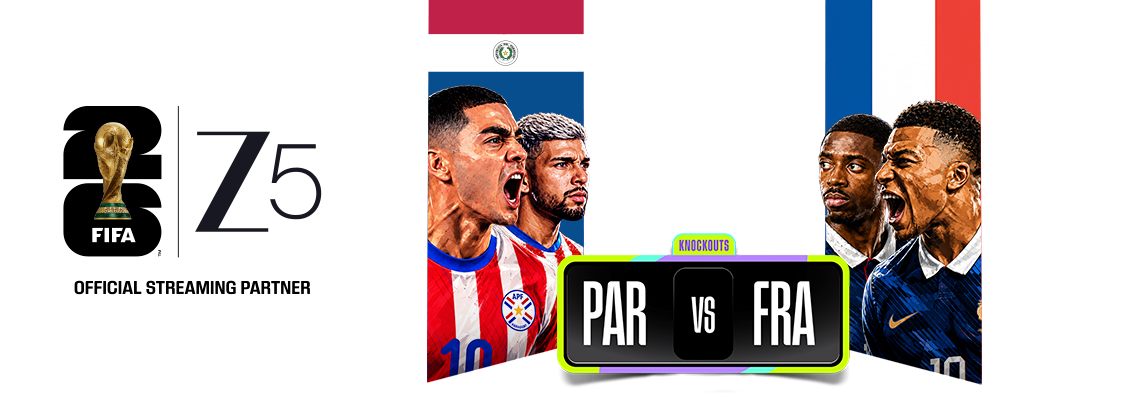
Round of 16 | Philadelphia Stadium | Sunday, 5 July — 2:30 AM IST
How They Line Up
France — 4-2-3-1
Mike Maignan in goal. Jules Koundé at right-back, Dayot Upamecano and William Saliba as the centre-back pairing, Lucas Digne at left-back. Adrien Rabiot and Aurélien Tchouaméni form the double pivot: Rabiot’s physicality and ball-carrying from deep, Tchouaméni’s positional discipline and reading of the corridor behind the attack. Michael Olise takes the central attacking midfield role — the position between the pivot and Mbappé — with Bradley Barcola operating from the left and Ousmane Dembélé from the right. Kylian Mbappé leads as the lone striker. With 18 World Cup goals — one behind Messi’s record — every touch he takes in Philadelphia carries that specific weight.
Paraguay — 4-4-2
Ángel Gill in goal. Alonso at left-back, José Canale and Gustavo Gómez as the centre-back pairing, Cáceres at right-back. Matías Galarza at left midfield, Juan Cubas and Andrés Bobadilla in the central midfield pair, Miguel Almirón at right midfield. Julio Enciso and Ávalos as the two forwards. Paraguay’s 4-4-2 changes shape depending on the phase: with the ball, a direct shape built around counter-attacking combinations through Enciso and Galarza; without it, two compact banks of four that drop deep and compress the central zones France need to operate in. Alfaro trusts the system. It stood strong against Germany for 90 minutes and survived extra time. The same discipline applied for 90 minutes against France would be the greatest night in Paraguay’s football history.
Watch the FIFA World Cup 2026™ live in India on ZEE 5. Choose the ₹799 quarterly plan or the ₹1,699 annual plan to stream every match of the tournament.
The Battles That Will Decide This Match
Kylian Mbappé vs Cáceres + Gómez — Most of Mbappé’s goals in this tournament have followed the same pattern: a pass from Olise or Dembélé, Mbappé arriving into the left channel, and a finish from around the left post before the goalkeeper has time to adjust. The delivery is precise, the run is timed, and the finish is almost always from that same left-side position — arriving late at an angle and cutting the ball across to the near corner. Alfaro’s defensive answer has to address two separate problems: preventing the ball from reaching him and closing the shooting space if it does.
The first problem belongs to Gómez and Cáceres working in combination. Cáceres has to read Mbappé’s run early enough to step and intercept the pass from Olise before it arrives in the left channel — positioning to cut the delivery rather than chasing Mbappé after it lands. That is easier to ask than to execute against a player whose movement begins before the ball is played. Cáceres has to deny Mbappé the receiving position entirely: if Mbappé checks into the channel and Cáceres is not tight enough, the turn and shot arrive before either defender can close the angle. If the ball does get through, Cáceres has to be immediately on him — forcing him away from the left-post position where he is most dangerous, pushing him central where Gómez can double up and limit the shooting angle. Paraguay don’t need to stop Mbappé from touching the ball. They need to stop him touching it in the one position from which he has done most of his damage in this tournament.
Michael Olise (CAM) vs Cubas + Bobadilla — Paraguay’s 4-4-2 defends with two compact lines of four. The zone between those lines — behind the midfield block and in front of the defensive pair — is the space Olise is positioned to exploit. His game in the central attacking role at Bayern Munich is built on exactly this: dropping short to receive, turning quickly in tight spaces, and releasing the ball before defenders can close around him. Cubas and Bobadilla have to decide every time Olise checks to receive from the pivot whether to press him immediately — stepping out of the midfield line — or to hold their shape and accept that he receives turned. If they step up, the space behind them opens for Barcola’s run from the left or Dembélé cutting from the right; if they hold, Olise receives turned in a position from which he can drive forward or play Mbappé in behind. The double pivot provides the circulation that creates the problem: Tchouaméni switches the ball wide to Koundé, Rabiot plays quickly into Olise’s feet before Bobadilla can close — two touches and France are in the space Paraguay are trying to keep compact. Whether Enciso and Ávalos can press Rabiot and Tchouaméni aggressively enough to prevent that first pivot pass is the opening phase that shapes the rest of the match.
Tactical Breakdown
Enciso and Ávalos pressing high will try to isolate Saliba and Upamecano in possession and force the long ball forward; with Rabiot and Tchouaméni sitting deep, France’s centre-backs have the option to play out through the pivot rather than kick long under pressure. When France build forward, Koundé’s overlapping runs from right-back into the space Dembélé creates when he drifts inside, and Digne advancing on the left when Barcola moves centrally to link with Olise, give France width from both full-backs. The delivery into the box — with Mbappé arriving between Gómez and Canale — is where France expect to score. Olise’s late run from deep into the area is the secondary threat that a defence managing Mbappé’s movement cannot simultaneously track.
ZEE 5 is the official streaming home for the FIFA World Cup 2026™ in India. France vs Paraguay kicks off at 2:30 AM IST on 5 July — check available ZEE 5 FIFA subscription plans and stream the match live.
Disclaimer: Subscription pack prices are subject to change from time to time. Please visit the subscription page for the most up-to-date pricing information.