





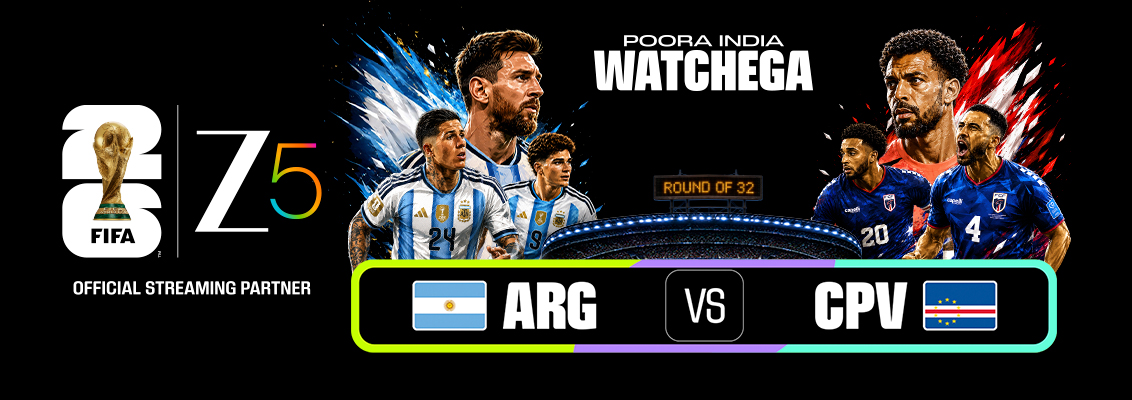
Round of 32 | Miami Stadium | Saturday, 4 July — 3:30 AM IST
How They Line Up
Argentina — 4-4-2
Emiliano Martínez in goal. Medina at left-back, Lisandro Martínez and Romero as the centre-back pairing, Molina at right-back — the defensive four that started the opening two group games. Alexis Mac Allister sits as the pivot below Rodrigo De Paul; Mac Allister’s ability to win it back and recycle immediately is what allows the team to press forward. Messi operates from the right but never stays there — he drifts into the right half-space, collects in pockets between Cabo Verde’s midfield line and defensive four, and makes the decisions that Argentina’s entire attacking structure rotates around. Almada plays as the advanced creative link, threading between lines when Messi draws the attention. Lautaro Martínez leads the line: first pressing trigger, the body who occupies both centre-backs and opens the central corridor for what arrives behind him.
Cabo Verde — 4-1-4-1
Vozinha in goal. Lopes Cabral at left-back, Borges and Lopes as the central defensive pair, Moreira at right-back. Monteiro, along with Pina, anchors the midfield — the players who compress the central corridor and ensure the block stays tight when Cabo Verde are under pressure, which against Argentina will be most of the match. Duarte sits to the right of Monteiro in the defensive midfield band. Cabral from the left and Mendes from the right provide the wide midfield coverage, responsible for tracking Argentina’s overlapping full-backs and denying the space those overlaps are designed to create. Livramento operates as the single forward — the transition outlet, asked to hold the ball when Cabo Verde wins it, giving the defensive block time to recover its shape before Argentina presses high to win it back.
Watch the FIFA World Cup 2026™ live in India on ZEE 5. Choose the ₹799 quarterly plan or the ₹1,699 annual plan to stream every match of the tournament.
The Battles That Will Decide This Match
Lionel Messi vs Borges & Lopes — the half-space problem Cabo Verde have no comfortable answer for — Messi’s most dangerous position in Argentina’s 4-4-2 is the right half-space: the zone between Cabo Verde’s left-back Lopes Cabral and left-sided centre-back Borges. He drifts inside from the right to collect there, and Bubista’s defensive shape has to choose between two options with no clean resolution. If Borges steps to press when Messi receives in this channel, the gap between the two centre-backs opens — and that is where Lautaro’s diagonal run arrives, behind the stepped defender, into space that doesn’t exist when the defensive line holds. If both centre-backs hold their line and surrender the touch, Messi gets a clean first touch in a position that gives him sight of goal or the pass to either side. Against Spain in Atlanta, Cabo Verde’s block was compact and disciplined enough to deny any individual sustained time in these pockets. Spain doesn’t have Messi. The specific problem he creates — dropping between the lines, receiving turned, and winning ball one-on-one — is one Borges and Lopes have spent the week preparing for and will spend 90 minutes in Miami trying to solve, without creating the other half of the problem.
Nahuel Molina vs Jovane Cabral — the width battle on Argentina’s right — When Messi drifts inside, Molina advances on the overlap. That is the sequence Argentina’s right flank is built around: Messi’s inside movement creates the outside lane, Molina arrives into it, and Cabo Verde’s left-sided wide midfielder — Cabral — is asked to track that overlap while also maintaining his position in the defensive block. Cabral is an attacking player by trade, an Estrela da Amadora winger who has spent this tournament defending from the left of a four-man midfield bank. His instinct is to press forward. His assignment in Miami is to hold his shape when Molina advances and force Argentina’s right-side combination to go backwards rather than find the overlap. When Messi receives inside, and Molina arrives on the outside simultaneously, Cabral has a decision to make: track Molina and leave a gap inside for De Paul’s arriving run, or hold the defensive line and give Molina a wide crossing position with Lautaro already positioned in the box. There is no good choice.
Tactical Breakdown
Bubista’s system against Argentina will look like the one that held Spain scoreless in Atlanta: a compact 4-5-1 mid-block, minimal space between the defensive and midfield lines, the entire structure designed to compress the central corridor where De Paul and Mac Allister want to combine. Monteiro and Duarte hold the double pivot position without the ball and ensure Messi can’t receive turned in the central zone — the block forces him wide or backwards before he can play the ball that hurts. The transition mechanism when Cabo Verde win possession is direct: Livramento holds up for the runners from midfield, Mendes and Cabral push forward on the wide channels, and the system looks for the early forward pass before Argentina’s press can set. Against the ball, Cabo Verde accept possession percentages of 30% or lower — that was the reality against Spain — and ask Vozinha to make the saves when the system can’t prevent the chance.
The specific sequence that breaks a mid-block of this kind — wide overload on one side, quick switch to the opposite flank, Molina arriving late into the vacated space — is exactly what Scaloni has prepared. The question is whether Cabo Verde’s shape is disciplined enough to hold it for 90 minutes against the defending world champions.
The Decisive Factor
The match will be decided on whether Vozinha can reproduce his group-stage form against a significantly higher volume and quality of chances than he faced from Spain or Uruguay. Those performances — the clean sheet against European champions, the saves that kept Cabo Verde level twice against Uruguay — were not flukes. His positioning, his decision-making under pressure in the six-yard box, and his shot-stopping quality from range are all genuine. But Messi in the half-space, Lautaro arriving in behind, Almada threading through the lines, and Molina with crossing positions from the right represent a different order of sustained attacking threat. The match will be decided not by the system holding — Bubista’s organisation will make Argentina work — but by whether Vozinha can keep the sequence of inevitable Argentina chances from becoming a scoreline that makes the result unchallengeable before the hour mark.
ZEE 5 is the official streaming home for the FIFA World Cup 2026™ in India. Argentina vs Cabo Verde kicks off at 3:30 AM IST on 4 July — check available ZEE 5 FIFA subscription plans and stream the match live.
Disclaimer: Subscription pack prices are subject to change from time to time. Please visit the subscription page for the most up-to-date pricing information.