




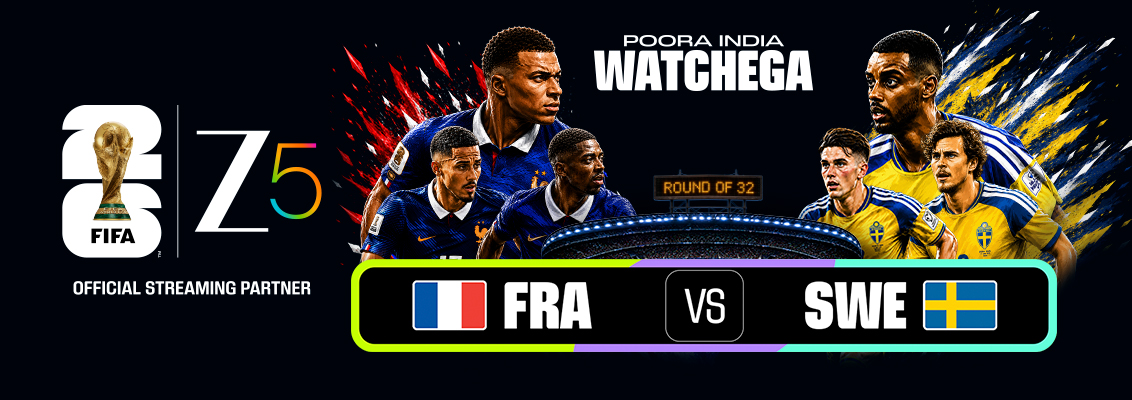
Round of 32 | FIFA World Cup 2026™
MetLife Stadium, New York/New Jersey | Tuesday, 1 July — 2:30 AM IST
How They Line Up
France — 4-2-3-1
Didier Deschamps returns to his first-choice setup after rotating in the Norway game. Mike Maignan in goal. Jules Koundé at right-back, William Saliba and Dayot Upamecano at centre-back, Theo Hernández at left-back — the defensive unit that has conceded once in the entire group stage. Aurélien Tchouaméni and Adrien Rabiot form the double pivot: Tchouaméni screens and covers the ground aggressively, Rabiot provides the physical presence and late arrivals into the box. Ousmane Dembélé starts from the right, Désiré Doué as the number ten, Michael Olise on the left. Kylian Mbappé leads the line. Every shape, every movement in this system runs through that front four — and Mbappé in behind any defensive line is a problem without a clean solution.
Sweden — 3-1-4-2
Graham Potter reverts to the 3-1-4-2 that carried Sweden through the Tunisia and Netherlands games. Robin Nordfeldt in goal. Marcus Hien, Tobias Lagerbielke, and Victor Lindelöf as the back three — Lindelöf operating on the left of the unit, the role he performed most comfortably through the group stage. Michael Karlström sits as the single pivot, a screening role designed to protect the back three in transition. Emil Gudmundsson functions as the right wing-back, pressing high when Sweden have the ball. Mattias Bernhardsson and Linus Ayari operate centrally. Patrik Nygren at left wing-back. Viktor Gyökeres and Alexander Isak as the forward partnership — the most dangerous two-striker combination at this tournament when they have space and service.
Watch the FIFA World Cup 2026™ live in India on ZEE 5. Choose the ₹799 quarterly plan or the ₹1,699 annual plan to stream every match of the tournament.
The Battles That Will Decide This Match
Viktor Gyökeres vs William Saliba & Dayot Upamecano — Gyökeres is the most physically complete centre-forward at this tournament. He drops deep to collect, turns in tight spaces, finishes with either foot, and wins aerial duels against defenders bigger than him. Saliba — his Arsenal teammate — knows exactly what he can do, which makes this one of the most intriguing technical duels of the round. Upamecano covers alongside and provides the pace to deal with Gyökeres running in behind. If France’s centre-back pairing can prevent him receiving with his back to goal and turning, Sweden’s most dangerous offensive mechanism is compromised. If Gyökeres gets even two or three touches in the area, France need to be clean every single time.
Kylian Mbappé vs Victor Lindelöf — Lindelöf is one of the most experienced defenders at this tournament — composed, a good reader of the game, strong in the air. But Mbappé’s acceleration in the first three yards is the one quality that experienced defenders can’t simply plan against. Lindelöf will be Sweden’s left-sided centre-back, the role he occupied through the group stage, and France’s attacking transitions are designed to find Mbappé in behind the defensive line before it can reset. When France win the ball in their own half, Mbappé is already moving. Lindelöf has to maintain his line and resist the temptation to step out, because the moment he commits, the space behind him is France’s in three seconds.
Alexander Isak vs Aurélien Tchouaméni — Isak’s role in Sweden’s 3-1-4-2 is more nuanced than his goals suggest. He drifts wide, drops into midfield pockets, and links the play between Gyökeres and the midfield four. Tchouaméni’s entire job in France’s double pivot is to identify and eliminate exactly these movements — the player who appears between the lines, receives on the half-turn, and plays the killer pass. Against Tunisia, Isak had freedom because the defensive block couldn’t track his runs. Against Tchouaméni, who covers the ground better than almost any defensive midfielder in the world, he’ll need to work significantly harder to find those same spaces. How often Isak receives facing goal rather than with his back to it will tell you most of what you need to know.
Ousmane Dembélé vs Patrik Nygren — Nygren is Sweden’s left wing-back — a role that involves him pushing forward in possession and dropping to cover as a left-sided defender when France attack. The problem is Dembélé. When France’s right winger has the ball in space, he is one of the most dangerous players in world football — quick, unpredictable with either foot, and comfortable beating defenders in one-on-one situations. Nygren pushing forward to support Sweden’s press is the same movement that creates the space Dembélé wants behind him. If Dembélé receives the ball after Nygren commits forward even once, the channel is open and France’s right side becomes the match’s defining corridor.
Tactical Breakdown
France’s system is built on winning the ball high and playing through at pace before Sweden’s defensive block can reorganise. Dembélé drives at Nygren, Olise attacks Gudmundsson on the other side, and Doué operates in the pockets between Karlström and the back three. The design is to make Karlström’s screening role impossible — one player cannot cover all three channels, so at least one of Doué, Dembélé, or Olise will find a moment of space. France have conceded once in three group games, and they haven’t needed to take risks to do it. Deschamps will protect first and trust the front four to create.
Sweden need to prevent France’s transitions from working in the first 20 minutes. Their 3-1-4-2 is most effective when the back three stays intact and Karlström limits the space between the lines. Against the Netherlands, Sweden couldn’t maintain this — the shape broke and the goals came quickly. Against France, the risk is identical: one defensive line error, one misread of Mbappé’s run, and the game opens up in a direction Sweden cannot recover from. Potter’s instruction will be to press France’s double pivot early and make possession difficult before Deschamps’ side establishes tempo. If Sweden can force France backwards for the first 15 minutes, this game becomes competitive.
The Decisive Factor
Whether Désiré Doué can operate freely between Karlström and Sweden’s back three. Doué — 20, PSG’s most technically gifted midfielder — reads spaces before they open and plays passes at a tempo that defensive lines find almost impossible to organise against. If Karlström tracks Doué into wide areas, the centre of the pitch opens for Rabiot’s runs. If Karlström holds his position, Doué will receive between the lines and play France through in three or four passes before Nordfeldt faces Mbappé. Sweden’s back three are disciplined. Their single pivot is the pressure point. Potter knows it and will have prepared for it — but France have been finding this space against every team in this tournament.
ZEE 5 is the official streaming home for the FIFA World Cup 2026™ in India. France vs Sweden kicks off at 2:30 AM IST on 1 July — check available ZEE 5 FIFA subscription plans and stream the match live.
Disclaimer: Subscription pack prices are subject to change from time to time. Please visit the subscription page for the most up-to-date pricing information.


