




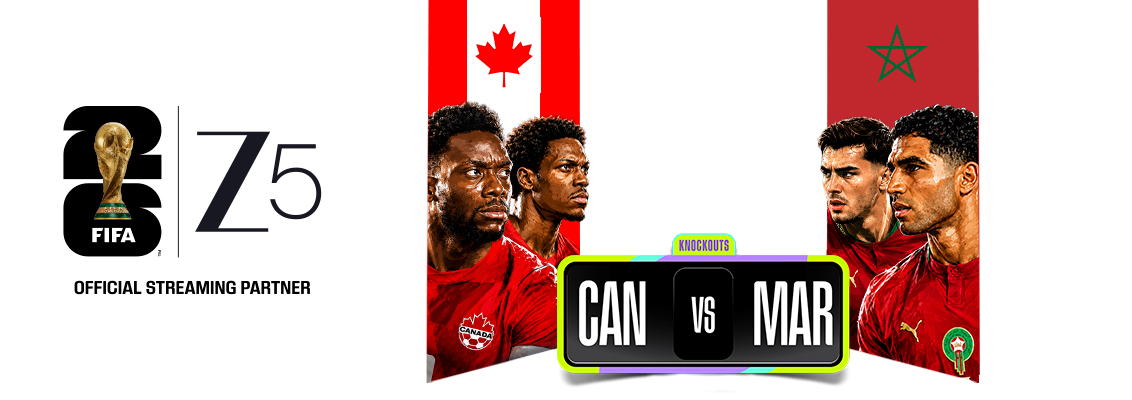
Round of 16 | Houston Stadium | Saturday, 4 July — 10:30 PM IST
Canada’s Plan — And Why It Nearly Worked
Canada came in with a clear idea. Morocco built almost everything from the back — ball through the goalkeeper and centre-backs, into the pivot, and then out wide to Hakimi, whose overlap transforms the 4-2-3-1 into something closer to a 2-4-3-1 in attack. Canada decided to attack that build-up before it could develop. Their 4-4-2 pressed aggressively in Morocco’s half, flooding the zone between Morocco’s defensive line and their double pivot with six players — both strikers and all four midfielders pressing as a unit. Morocco couldn’t find their usual rhythm. Passes went backwards, recycled sideways, interrupted at every turn. The Moroccan build-up play that has been their attacking foundation all tournament looked suffocated from the opening whistle.
The pressure produced territory and chances. Canada won three consecutive corners inside the first six minutes — each one a direct product of Morocco’s back line being forced into mistakes. Their best opportunity came when Oluwaseyi found himself one-on-one with Yassine Bounou. It was exactly the kind of chance Canada’s press was designed to create. Bounou made the save. Canada couldn’t convert, and that miss — in retrospect — became the defining moment of the match.
Morocco Absorb, Then Slow It Down
Canada’s pressing game required every outfield player to press at high intensity simultaneously. Morocco couldn’t build through their usual channels, but they adapted: shorter passes, switched to a more direct approach, and gradually — over the course of the first half — began to slow the game to their own tempo. Canada was winning the press but spending energy doing it. Morocco’s experience at this level, built over a generation of players competing in Europe’s top leagues, showed in the collective composure they maintained under pressure. They had not been outplayed — just redirected.
Watch the FIFA World Cup 2026™ live in India on ZEE 5. Choose the ₹799 quarterly plan or the ₹1,699 annual plan to stream every match of the tournament.
The Goal That Broke Canada
The second half began with Morocco controlling the tempo rather than chasing it. Brahim Díaz, outstanding throughout, found Rahimi deep on the right flank. Luc de Fougerolles, tracking back to clear, committed the foul. Free kick, just outside the area, with Achraf Hakimi standing over the ball.
What Hakimi did next was not what anyone expected. Rather than swinging a cross into the box — where Canada’s defenders were crowded and positioned — he rolled a precise, low ball sideways across the face of the penalty area. Azzedine Ounahi was standing completely unmarked on the edge of the box. First time, no hesitation, he swept the ball cleanly through a crowd of bodies, curling it into Maxime Crépeau’s bottom left corner. It was a goal built on intelligence and composure in equal measure. Morocco 1-0.
Canada’s Collapse — Morocco’s Clinical Counter
Canada needed to respond. They pushed more players forward, committing bodies into Morocco’s half to find an equaliser. It was exactly the scenario Morocco had been waiting for. The same Canadian defensive structure that had been organised and disciplined in the first half began to come apart as the team stretched. Morocco, who had spent the first half containing Canada’s press, were now able to exploit the spaces opening up behind Canada’s advancing midfield. The transition moments were the story of the second half — Morocco winning the ball, Díaz carrying forward quickly, wide players finding space that no longer had tracking defenders.
Ounahi scored again. Then Morocco converted a third.. The final statistics told the story with brutal clarity: Morocco had five shots, four on target, three goals, and one crossbar. Canada had ten shots and scored none. Bounou’s save from Oluwaseyi in the first half, and those first six minutes of corners that went unconverted, were the difference between a result and a statement.
Star Performers
Yassine Bounou — The save from Oluwaseyi in the first half was the intervention that kept Morocco level when they were at their most vulnerable. Had Canada scored then, with the press still at full intensity and Morocco’s build-up disrupted, this could have been a very different match. Bounou made the key decision at the key moment.
Brahim Díaz — The standout performer on the pitch. Díaz was involved in the build-up to all three goals and won the midfield battle comprehensively in the second half. He had two assists to his name. He was the player who found Rahimi for the free kick sequence, the player who drove Morocco forward in transition, and the player who consistently found pockets of space between Canada’s two banks of four once the press had lost its early intensity.
Azzedine Ounahi — A brace in a knockout match at a World Cup. The first goal — the precision of his first-time technique through a crowded penalty area — was the defining moment of the match. The second confirmed it. Ounahi arrived in this tournament underappreciated and leaves the round of 16 as one of its most important players.
The Verdict
Canada played their best football in the first 45 minutes and got nothing for it. Morocco survived the storm, changed the tempo, and then executed with a precision that Canada, for all their energy and organisation, couldn’t match. The 3-0 scoreline overstates the gap — this was competitive until Hakimi’s free kick — but Morocco’s efficiency in converting their limited opportunities was a statement in itself. They advance to the quarter-finals. Canada go home, having finally broken a 40-year knockout drought in the round of 32 and played well enough to believe the next generation can go further still.
ZEE 5 is the official streaming home for the FIFA World Cup 2026™ in India. Don’t miss a single moment of the quarter-finals — check available ZEE 5 FIFA subscription plans and stream every match live.
Disclaimer: Subscription pack prices are subject to change from time to time. Please visit the subscription page for the most up-to-date pricing information.