




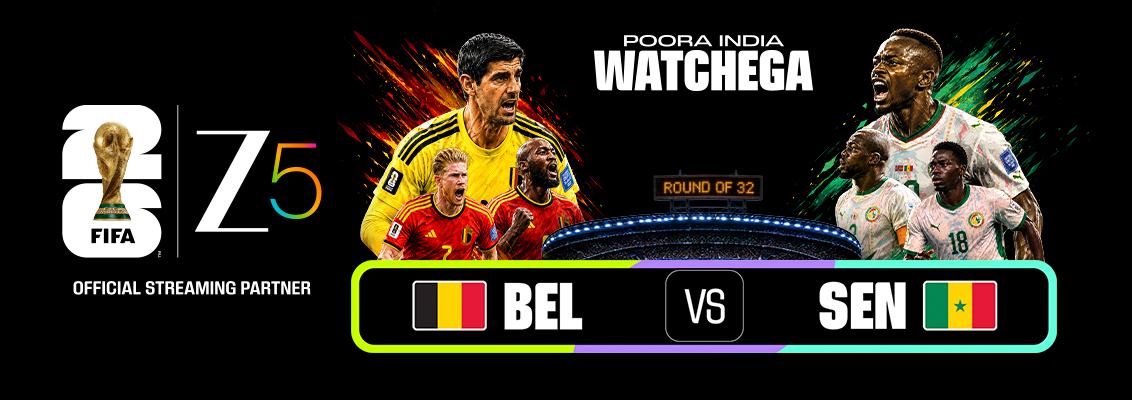
Round of 32 | Seattle Stadium | Wednesday, 2 July — 1:30 AM IST
How They Line Up
Belgium — 4-2-3-1
Thibaut Courtois in goal. Thomas Meunier at right-back — Belgium’s most experienced defensive option in wide areas at this level — Brandon Mechele and Nathan Ngoy as the centre-back pairing, with Ngoy returning from the suspension he served against New Zealand. Maxim De Cuyper at left-back. Youri Tielemans and Amadou Onana in the double pivot: Tielemans covers the defensive transitions and distributes with composure from deep; Onana brings intensity and physical aggression to the press. Leandro Trossard operates from the right of the three, Kevin De Bruyne at ten, Jeremy Doku from the left. Charles De Ketelaere leads the line, though Romelu Lukaku — who came on against Egypt and immediately changed the dynamic of that match — gives Garcia a physically imposing option from the bench.
Senegal — 4-2-3-1
Édouard Mendy in goal. Diouf at right-back, Moussa Niakhaté and Kalidou Koulibaly as the centre-back pairing — Koulibaly with the authority and experience of someone who has organised defences at the highest level of European football for well over a decade, Niakhaté the composed organiser alongside him. Diatta at left-back. Idrissa Gana Gueye and Pape Gueye form the double pivot: Idrissa handles the aggressive pressing and sets the defensive tempo, while Pape provides the technical range and spatial cover. Lamine Camara at ten — the most technically complete central midfielder Senegal have had in a generation. Ismaïla Sarr runs from the right channel, Sadio Mané from the left. Nicolas Jackson leads the line.
Watch the FIFA World Cup 2026™ live in India on ZEE 5. Choose the ₹799 quarterly plan or the ₹1,699 annual plan to stream every match of the tournament.
The Battles That Will Decide This Match
Jeremy Doku vs Diouf — Doku is Belgium’s most dangerous weapon when space opens up. At full pace down Belgium’s right side, he’s almost impossible to contain in a one-on-one situation — his ability to attack in both directions makes it nearly impossible to press him into a corner. He’ll spend the evening targeting Diouf’s right-back position, and if he gets behind the Senegalese full-back, the damage from crosses and cutbacks can be decisive. Diouf has to hold his position and resist the pressure to step and commit. The moment Diouf presses and Doku gets behind, Belgium have a chance in the area. How Senegal’s left side handles that pressure — and whether Idrissa Gueye provides cover to double up when needed — will define Belgium’s most dangerous corridor all evening.
Kevin De Bruyne vs Idrissa Gana Gueye — Every team facing Belgium in this tournament knows what De Bruyne needs to be denied: the half-turn in the central zone, two yards of space to pick his head up and play. Idrissa Gueye spent years at Everton and PSG making exactly this space disappear for some of the best players in European football. His pressing trigger — when to step, when to hold, when to drop — is the most refined in Senegal’s squad. If he gets close to De Bruyne early and forces Belgium’s best player into hurried passes and backward distributions, Senegal control the match’s rhythm without needing to build much of their own. If De Bruyne finds the pocket between the double pivot and the attacking line, Belgium’s attack organises itself.
Nicolas Jackson vs Mechele & Ngoy — Jackson’s movement is the piece of Senegal’s attack that Belgium’s centre-backs need to track most carefully. He runs in behind the last line, links when the ball is played short, and makes diagonal runs across the block that pull centre-backs away from their defensive positions. Mechele has been Belgium’s most consistent defender through the group stage — reading the game early, winning his aerial duels. Ngoy returns from suspension and brings physicality. Senegal’s counter-attacks in Seattle depend on Jackson receiving the ball quickly, holding it, and creating the second chance for Camara arriving from deep. If Mechele and Ngoy cut off his supply early, Senegal’s offensive transition loses its most important link.
Sadio Mané vs Thomas Meunier — Mané operating from the left of Senegal’s AMF three will attack Meunier’s right-back position throughout this match. At 34, he doesn’t run at defenders the way he did at Liverpool — his game has shifted toward positioning, reading space before it opens, and arriving in the pocket between defence and midfield with one touch to play. Meunier is physically strong and has the experience to deal with direct wingers, but Mané’s game is more subtle than pace alone. If he drops into the half-space with Meunier five yards away and facing the wrong direction, the quality to find Jackson or Sarr with one pass is still fully there. This is the battle that won’t be the headline going into the match — and the one that will shape where Senegal’s best chances come from.
Tactical Breakdown
Both sides play 4-2-3-1, meaning the match’s shape is determined by whose double pivot wins its central battle. Idrissa Gueye and Pape Gueye are tasked with denying De Bruyne time and space; Tielemans and Onana are tasked with preventing Camara from operating freely as the number ten he was across Senegal’s first two games. When both pairs cancel each other out, the match opens on the flanks. Doku vs Diouf, Sarr vs De Cuyper on Belgium’s right become the deciding corridors — and both are matchups where individual quality rather than structural advantage settles the outcome.
Senegal’s most effective moments in the group stage came from compact defensive shape followed by quick transition. Against France they held the block for long periods before the quality gap told; against Norway they twice fought back from behind through exactly this pattern. Belgium have to hold their defensive shape and avoid being stretched — if Jackson receives on the half-turn with Mechele or Ngoy still recovering, the diagonal runs from Mané on one side and Sarr on the other create simultaneous decisions no central defender can fully cover. Garcia’s instruction to his double pivot will be to hold compactly and not both press at the same time. One presses; one covers.
The Decisive Factor
Belgium rotated both midfield slots across the group stage — Onana started MD1, Raskin replaced him for MD2, Vanaken came in for MD3. Garcia needs Tielemans and Onana to function as his first-choice pivot and give De Bruyne the platform to operate freely at ten. If Idrissa Gueye tracks De Bruyne’s movement aggressively and forces him into positions facing his own goal, Belgium’s most reliable creative mechanism is compressed from the first whistle. If De Bruyne finds the half-turn position two or three times in the opening period, Doku’s runs and Trossard’s arrivals will do the rest.
ZEE 5 is the official streaming home for the FIFA World Cup 2026™ in India. Belgium vs Senegal kicks off at 1:30 AM IST on 2 July — check available ZEE5 FIFA subscription plans and stream the match live.
Disclaimer: Subscription pack prices are subject to change from time to time. Please visit the subscription page for the most up-to-date pricing information.


