





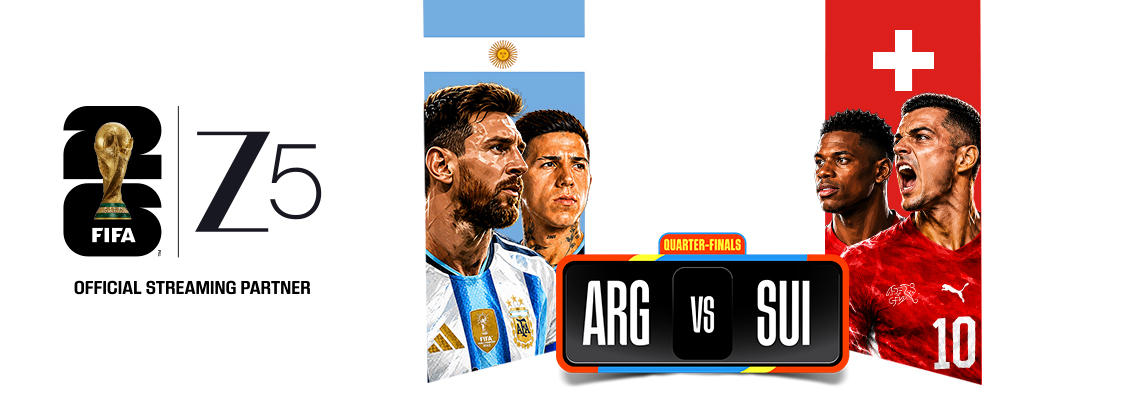
Quarter-Final | Kansas City Stadium | Saturday, 12 July — 6:30 AM IST
Expected Line-Ups
Argentina — 4-1-3-2
Emiliano Martínez is expected in goal. Nicolás Tagliafico at left-back, Lisandro Martínez and Cristian Romero as the centre-back pairing, Nahuel Molina at right-back. Leandro Paredes as the sole defensive pivot. Alexis Mac Allister from the left, Enzo Fernández centrally, Rodrigo De Paul from the right. Lautaro Martínez and Lionel Messi as the predicted twin strikers.
Argentina have not settled on a formation in this tournament. They lined up in a 4-1-2-3 against Cabo Verde, used variations throughout the group stage, and the 4-1-3-2 now represents their most aggressive attacking shape. The logic is specific to this opponent: without a natural defensive winger in the starting lineup, Switzerland’s fullbacks are freed from tracking a wide threat — but Argentina’s three central midfielders can flood through the zones between Xhaka’s line and the Swiss back four before the shape resets. The structure demands more from Paredes as the lone shield; it gives everything else to the attack.
Switzerland — 4-3-3
Gregor Kobel is expected in goal. Ricardo Rodríguez at left-back, Manuel Akanji and Nico Elvedi as the centre-back pairing, Denis Zakaria at right-back. Granit Xhaka and Remo Freuler as the midfield base, with Djibril Sow or Fabian Rieder completing the three. Dan Ndoye from the right, Breel Embolo through the centre, Rubén Vargas from the left.
Manzambi’s absence is structural, not cosmetic. He was the player who operated between the lines — the ten who triggered Switzerland’s best attacking sequences by receiving, turning, and releasing Ndoye or Embolo in one touch. Neither Sow nor Rieder provides that function naturally. Sow is more defensive; Rieder offers more creativity but less physicality in the press. Either choice leaves Switzerland flatter in attack than Yakin planned, and more dependent on individual moments from Ndoye and Embolo than on combined movement.
Watch the FIFA World Cup 2026™ live in India on ZEE 5. Choose the ₹799 quarterly plan or the ₹1,699 annual plan to stream every match of the tournament.
The Tactical Battles
Messi dropping deep — the dilemma for Akanji and Elvedi — In the 4-1-3-2, Messi is not asked to hold a wide position. He’s expected to receive centrally or in the right half-space, drop to collect, and play — either the through ball for Lautaro or the switch for Mac Allister arriving from deep. That puts Akanji in an impossible decision: follow Messi and vacate the central lane for Lautaro’s run, or hold the line and give Messi time and space on the ball. Switzerland haven’t faced this problem all tournament because no team has sent a player of Messi’s quality into that exact zone. Akanji is Switzerland’s best reader of the game, but this is a different class of problem.
Mac Allister and De Paul bombing forward — Zakaria’s yellow card test — The 4-1-3-2 gives Mac Allister and De Paul licence to push into the box from deep, arriving late after Messi or Fernández hold the ball centrally. Mac Allister’s runs from the left will repeatedly cross into the space behind Zakaria, who is already on a yellow card. Tracking those runs cleanly — without a foul, without over-committing — while also managing Tagliafico’s overlapping position is a dual responsibility Zakaria hasn’t been asked to handle all tournament.
The Decisive Factor
Paredes carries an enormous responsibility as the lone pivot. Argentina’s three midfielders ahead of him are attack-oriented — Mac Allister and De Paul push high, Fernández links rather than screens. When Switzerland win the ball in midfield, the transition runs through Ndoye, who has the pace to punish Tagliafico before Paredes can recover across. Switzerland’s counter-attacking game against Argentina’s high line is their most realistic route to a goal, and it depends almost entirely on whether Paredes reads and intercepts those moments before they develop. Get it right, and Argentina’s attacking overload produces the goals their formation promises. Lose the battle in that pivot zone once or twice, and Switzerland’s tournament survival instinct — which has carried them past Algeria and Colombia — becomes relevant again.
ZEE 5 is the official streaming home for the FIFA World Cup 2026™ in India. Argentina vs Switzerland kicks off at 6:30 AM IST on 12 July — check available ZEE 5 FIFA subscription plans and stream the match live.
Disclaimer: Subscription pack prices are subject to change from time to time. Please visit the subscription page for the most up-to-date pricing information.


