




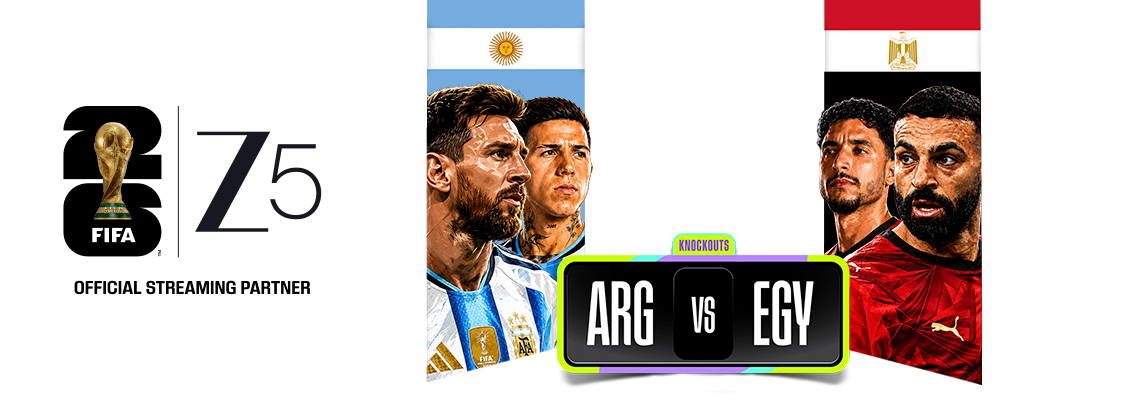
For 67 minutes at the Atlanta Stadium, Egypt’s tactical plan worked. Argentina’s 4-1-3-2 was neutralised, Messi’s penalty was saved, and an Egyptian double pivot controlled the match’s engine room. Then came the substitutions. Then came the comeback. The story of this match is really two matches in one.
Watch Argentina’s FIFA World Cup 2026™ quarter-final live on ZEE 5. Subscribe to the ZEE 5 FIFA Subscription Quarterly Plan at ₹799 — every remaining match live in India.
The Formations: 4-1-3-2 vs 4-2-3-1
Argentina set up in a 4-1-3-2. Leandro Paredes operated as the lone pivot, shielding the back four and distributing from deep. Ahead of him, Mac Allister, Fernández, and De Paul formed a three-man midfield band. Messi and Julián Álvarez played as twin strikers — Messi dropping off to link play, Álvarez making runs in behind Egypt’s defensive line.
Egypt responded with a 4-2-3-1. Mohanad Lashin and Marawan Attia formed a double pivot that sat compact and deep, denying Paredes any free space to operate. Mohamed Salah dropped into the number 10 role behind lone striker Mostafa Zico — an unusual position for him, but tactically deliberate, giving Egypt a creative player between the lines while Haissem Hassan and Emam Ashour provided the width.
Egypt’s Double Pivot vs Paredes — The First-Half Tactical Win
The key structural contest in the first half was Paredes against Egypt’s two-man pivot. In theory, a single holding midfielder should be outnumbered by a double pivot. In practice, Egypt exploited this to the fullest. Every time Paredes received the ball and tried to play forward, Lashin or Attia was already positioned to press. Argentina’s midfield three of Mac Allister, Fernández, and De Paul had to drop deeper to find the ball, which in turn reduced the pressure on Egypt’s backline.
Argentina still created chances — Mac Allister’s close-range header forced Shobeir into a sharp save, and the cut-back to Álvarez in the 39th minute drew another. But the quality of the positions Argentina reached was lower than their overall possession warranted. Egypt’s pivot was the reason.
Salah in the Number 10 Role — Egypt’s Creative Hub
Playing Salah as a number 10 rather than a wide forward was Osama Nadeem’s most significant tactical decision. It gave Egypt a player of genuine technical quality in the space between Argentina’s midfield three and their back four — a zone that Paredes alone could not cover.
Salah’s role in the 67th-minute goal illustrated why the decision worked. His pass released Hassan on the right wing, whose cut-back found Zico for a clinical finish. That move was built on the freedom Salah had been given in the central pocket throughout the match. Argentina’s midfield three was stretched wide enough that the central channel remained open whenever Egypt won the ball and transitioned.
Set-Pieces — Egypt’s Planned Advantage
Egypt’s opening goal came from a set-piece corner — Attia’s delivery, Ibrahim’s header over Lisandro Martínez. This was not accidental. Egypt had identified Argentina’s vulnerability from aerial deliveries and had practiced the routine. Ibrahim’s run, perfectly timed between Argentina’s two centre-backs, exposed the gap that a zonal marking system leaves when defenders are out-jumped.
Argentina’s three goals in the fightback also came largely from set-piece situations or crosses — Romero’s header in the 79th minute, the floated delivery from the right that Montiel kept alive before Messi struck, and Fernández’s header from a Lautaro Martínez cross. Both sides used dead-ball situations to their advantage. Egypt just found theirs earlier.
The Substitutions — Scaloni’s Game-Changer
The match turned at the second hydration break when Scaloni introduced Nico González and Lautaro Martínez. The effect was immediate and structural. Lautaro’s movement gave Argentina a genuine target in behind Egypt’s defensive line — something that Álvarez, dropping deeper to link play, was not providing. González added direct running that Egypt’s full-backs, who had been comfortable in their shape, had no answer for.
The 4-1-3-2 shifted shape with the changes. Messi dropped slightly deeper while Lautaro led the line. Argentina’s attacks became more vertical, less patient. Egypt had defended patience well for 67 minutes. They had less of an answer for the direct ball.
Watch Argentina’s quarter-final live on ZEE 5 — the exclusive home of FIFA World Cup 2026™ in India. Don’t miss it.
Disclaimer: Subscription pack prices are subject to change from time to time. Please visit the subscription page for the most up-to-date pricing information.


