




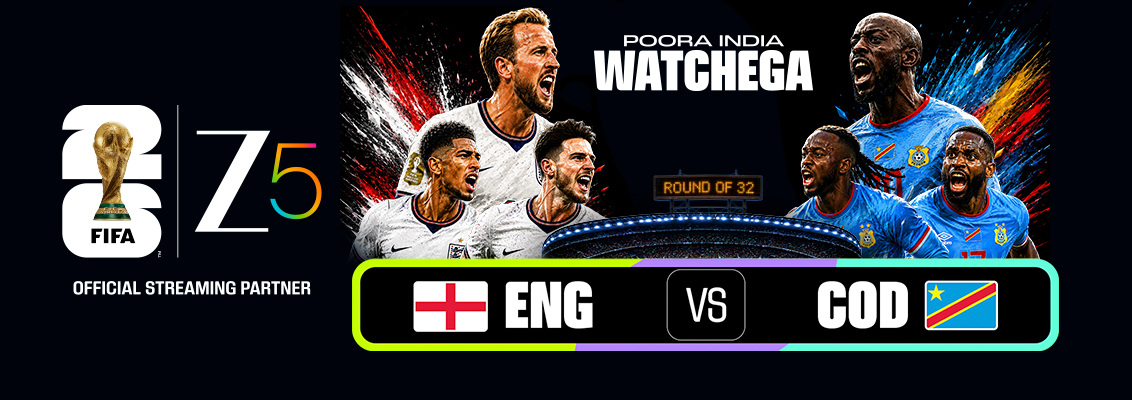
Round of 32 | Atlanta Stadium | Tuesday, 1 July — 9:30 PM IST
How They Line Up
England — 4-2-3-1
Jordan Pickford in goal. Nico O’Reilly at right-back, John Stones and Ezri Konsa as the centre-back pairing — Konsa has started every group game and Stones alongside him gives Tuchel the defensive base he trusts. Reece James at left-back, fit after the hamstring precaution against Panama. Declan Rice anchors the double pivot, covering the ground and regaining possession quickly; Anderson alongside him provides technical quality and late runs from the second line. Anthony Gordon operates from the left, Jude Bellingham as the number ten, dropping between the lines and arriving late in the box, and Noni Madueke on the right. Harry Kane leads the line.
DR Congo — 5-3-2
Mpasi in goal. Arthur Masuaku at left wing-back — the same position from which he created the cross for Wissa’s equaliser against Portugal. The back three of Kapuadi, Chancel Mbemba, and Axel Tuanzebe forms the defensive core: Mbemba, 100-plus caps at Lille and the team’s captain, at the centre. Aaron Wan-Bissaka covers the right wing-back role. The midfield three of Kayembe, Moutoussamy, and Mukau screen in front of the back line and deny space between the lines. Yoane Wissa and Cédric Bakambu lead the attack — Wissa the pace and direct threat, Bakambu’s 21 international goals providing the clinical quality to punish any lapse in concentration.
Watch the FIFA World Cup 2026™ live in India on ZEE 5. Choose the ₹799 quarterly plan or the ₹1,699 annual plan to stream every match of the tournament.
The Battles That Will Decide This Match
Jude Bellingham vs Kayembe & Moutoussamy — DR Congo’s central midfield pair have one instruction above all others in Atlanta: deny Bellingham the half-turn. He’s not a conventional number ten — he reads spaces before they open, drops to receive, and arrives in the box at exactly the wrong moment for whoever is defending. Against Croatia he scored. Against Ghana he was England’s most influential creative force even in a goalless draw. Kayembe and Moutoussamy form the screening double act in DR Congo’s midfield three, and their primary task is to push Bellingham deep and force him to receive facing his own goal. Every time he gets the ball turned and facing forward in that zone, England are dangerous. If the midfield block holds, England’s most reliable creative mechanism is cut off.
Harry Kane vs Mbemba & Tuanzebe — Kane’s movement between the lines and his ability to drop, link, and then spin beyond the defensive line is a combination that even experienced centre-backs struggle to contain for 90 minutes. Mbemba reads the striker’s movement early and has the physical authority to win the aerial duel when balls are played long. Tuanzebe’s pace alongside him covers the runs in behind. DR Congo’s back three allows the wing-backs to tuck in when England build centrally, meaning Mbemba and Tuanzebe never find themselves isolated against Kane alone. But when Kane creates the half-second of space at the edge of the box, his finishing accuracy means every DR Congo defender in Atlanta is watching.
Yoane Wissa vs Stones & Konsa — Wissa’s role in the 5-3-2 is to be the outlet — receive the ball quickly when England lose possession in the middle third and carry it forward before the defensive line can reset. Against Portugal, he arrived at the back post to head in the equaliser. Against Colombia, he was DR Congo’s most dangerous player in the moments Desabre’s side got forward. Stones’ positioning covers the diagonal run early; Konsa’s athleticism deals with the ball played in behind. The difficulty is that Bakambu creates a second decision — Wissa running one side, Bakambu occupying the other. Tuchel’s defensive shape relies on England winning possession before Wissa can build a head of steam.
Anthony Gordon vs Aaron Wan-Bissaka — The most unusual battle in this round. Gordon has been England’s most consistent wide performer in the group stage — direct, effective on the right, capable of moments that change matches. He’ll spend the evening attacking Wan-Bissaka’s flank. The complication is that Wan-Bissaka was born in Croydon, built his career at Crystal Palace and Manchester United, and knows Premier League wide forwards at a technical and physical level that makes a guessing game impossible. He knows how Gordon moves, how he cuts inside, and where the shot goes. For Gordon, beating Wan-Bissaka won’t just require quality — it’ll require something the DR Congo right wing-back hasn’t seen from the English game before.
Tactical Breakdown
England’s 4-2-3-1 against DR Congo’s 5-3-2 creates a numbers advantage in the wide areas when Gordon and Madueke push high. Tuchel wants the wide players to engage Wan-Bissaka and Masuaku aggressively — if the wing-backs are pinned back defensively, the central spaces tighten, and Bellingham can receive in the pocket between DR Congo’s midfield and back three. Rice drives the press from deep; Anderson provides the passing range to switch quickly. The key moment comes when England win the ball in midfield and play quickly before DR Congo’s defensive block can reorganise — that’s when the combination of Gordon’s run and Bellingham’s late arrival becomes genuinely difficult to defend.
DR Congo’s 5-3-2 is designed to absorb pressure and prevent exactly this kind of central opening. The back three holds deep, the midfield three screens tightly, and Wan-Bissaka and Masuaku provide width without abandoning defensive shape. Against Colombia’s possession-based approach, this structure held for long periods. The danger is the transition: the moment England’s fullbacks push high, and Rice is caught forward, the channel for Wissa’s run behind opens. If DR Congo can survive England’s pressure in the first 20 minutes, the match gets harder for the Three Lions — and easier for the Leopards.
The Decisive Factor
The question is whether England can find the central space behind DR Congo’s midfield in the first half-hour. The 5-3-2 is most vulnerable before the defensive structure fully settles into its rhythm and the midfield three locks into their screening positions. If Bellingham receives in that space early — before Kayembe and Moutoussamy have tuned their pressing triggers — England create a chance that changes the game’s dynamic. A goal forces DR Congo higher and generates the wider spaces Gordon wants. If DR Congo hold the shape until half-time, Desabre’s team arrives in the second half exactly where they performed best across all three group games: defending deep, waiting for their moment, and Wissa already running.
ZEE 5 is the official streaming home for the FIFA World Cup 2026™ in India. England vs DR Congo kicks off at 9:30 PM IST on 1 July — check available ZEE 5 FIFA subscription plans and stream the match live.
Disclaimer: Subscription pack prices are subject to change from time to time. Please visit the subscription page for the most up-to-date pricing information.


