





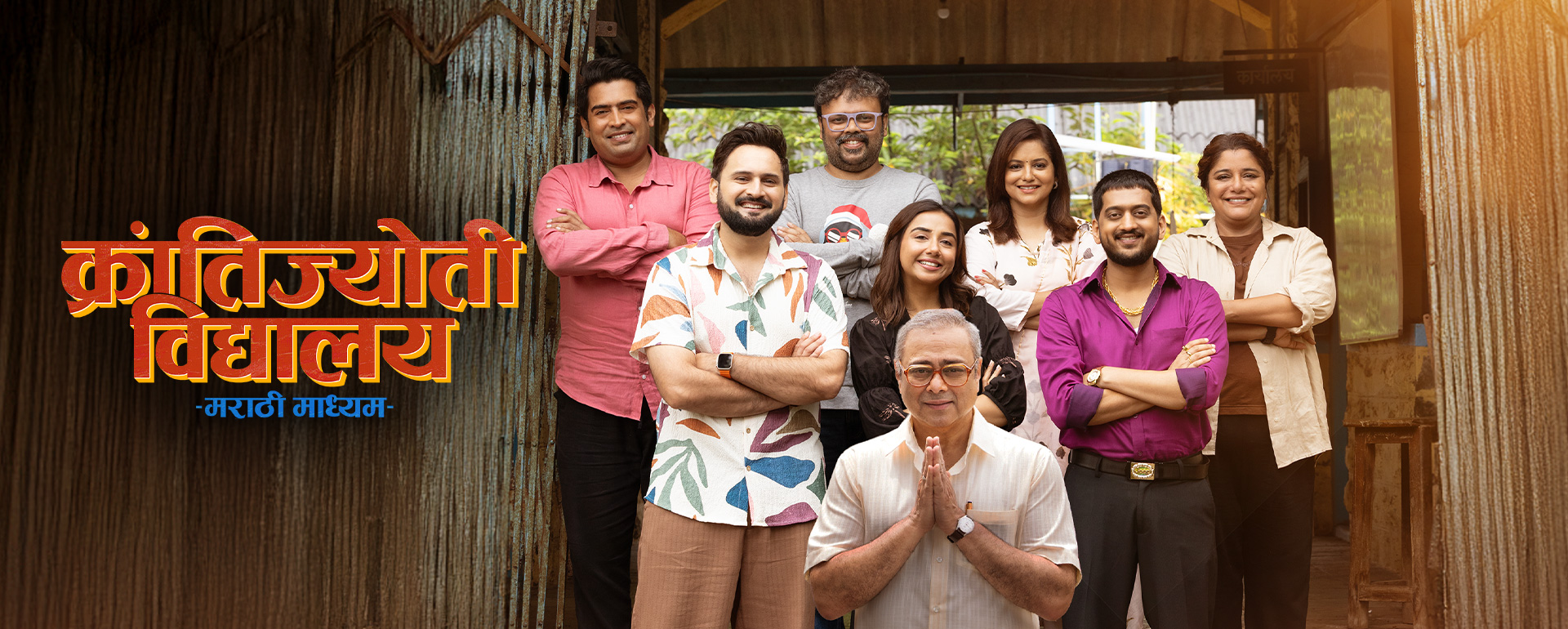
If you studied in Maharashtra, you know this soundscape. A bell rings out. Wooden benches scrape. Someone passes a bite of vada-pav, while a teacher claims the room with a firm voice. Krantijyoti Vidyalay Marathi Madhyam brings back that scene, since the film centres on a Marathi-medium school that fights to stay alive, and ZEE5 streams it from 27 February 2026.
The plot then asks something many avoid: where did these actors start school, and what do those early days show about Marathi-medium learning now?
Why This Story Feels Personal
In Krantijyoti Vidyalay Marathi Madhyam, Principal Dinkar Shirke reaches out to former students to save his school from collapse. The Marathi film frames a larger worry too: Marathi-medium schools face pressure in modern Maharashtra, and the conversation turns into “practical” versus “emotional.”
Here is a walk back to the blackboards for the principal cast. We use public sources for school and college details. Some artists keep school names private, so we stick to what they have shared.
Prajakta Koli: Thane Classrooms, Big Dreams
Prajakta Koli grew up in Thane and went to Vasant Vihar High School. She then chose mass media at V. G. Vaze College in Mulund. The school followed an English-medium ICSE pattern.
Her part in this film about a Marathi-medium school stands out, as many students in Maharashtra live between two worlds. They talk in Marathi at home. They joke in Marathi with friends. Still, they study in English at school. The story of this drama movie explores what changes when Marathi stays beyond the classroom door.
Siddharth Chandekar: Early Years in Pune
Siddharth Chandekar completed his schooling at S D Katariya High School in Pune before he entered Sir Parshurambhau College. Local information states that the school provides Marathi, Hindi, and English for students to study.
That detail fits the film’s larger point. Many families do not switch values when they switch media. They switch for access, exams, and jobs. The best schools protect the child’s mother tongue along the way.
Amey Wagh: Pune, Theatre, And A Performer’s Foundation
Amey Wagh studied at Brihan Maharashtra College of Commerce (BMCC), Pune. Profiles and school posts link him with Crescent High School in Pune. Crescent’s public listings describe English as the language of instruction.
Yet Pune’s streets run on Marathi. Friends, bus conductors, tuition teachers, and stage groups keep the language alive. Amey’s Marathi screen work in this comedy movie shows how that cultural current shapes a performer, no matter what language the textbooks are used in.
Kshitee Jog: English-Medium School, Marathi At Home
Kshitee Jog presents a human side to this issue. In her own writing, she explains that she studied in an English-medium school, and her parents taught Marathi poems and traditions at home; they kept many Marathi books.
That detail matters. Marathi-medium schools give many children what some families build with effort at home: comfort with Marathi reading, writing, and self-expression.
Sachin Khedekar: A College Stage That Trained A Principal
Sachin Khedekar takes on Principal Dinkar Shirke and carries the depth of Marathi theatre in his speech. In an interview, he remembers college days, stage roles in Marathi drama, and his first steps with theatre mentor Vinay Apte.
A principal does not rely on rules alone. He convinces teachers. He meets his parents. He leads students each day. Theatre teaches rhythm, attention, and the power to hold a crowd without shouting.
What Marathi-Medium Schools Give Beyond Language
A Marathi-medium school gives a child a straight road to meaning. The child answers in the language that forms their inner voice, so the child raises a hand more and asks better questions. Teachers can push thinking, not translation. A firm start allows children to grasp new languages, as they hold clear thoughts before new words arrive. UNESCO and UNICEF explain that mother tongue education boosts mental growth and school success.
That difference explains why this film belongs on your Marathi movies watchlist, whatever your school medium.
Why Marathi-Medium Schools Matter In 2026
Krantijyoti Vidyalay Marathi Madhyam arrives at a moment when language debates feel loud. Research keeps the message plain: children learn concepts faster when they start in a language they understand at a deep level. UNESCO notes that mother-tongue education supports inclusion and improves learning outcomes, with strong value in primary years.
This does not mean families must reject English. Marathi-medium schools deserve honour, help, and pride from society. Maharashtra orders each school to teach Marathi, whatever board or language they use.
The film reveals one basic truth: a Marathi-medium school forms more than language skills. It trains a child to think without translation. It allows a child to debate, joke, question, and imagine in the language that first described the world.
A Weekend Challenge for Your Old Memories
When you watch Krantijyoti Vidyalay Marathi Madhyam on ZEE5, listen for the classroom sounds. Think of your favourite teacher. Then ask yourself: who taught you your first confidence? A parent, a teacher, a friend, a school?
If your answer includes a Marathi-medium classroom, this Marathi drama movie will feel like a reunion. If your answer does not, the film still offers a window into why Marathi movies keep returning to the schoolyard. The schoolyard carries our first language, our first community, and our first idea of who we can become.
Bio of Author: Gayatri Tiwari is an experienced digital strategist and entertainment writer, bringing 20+ years of content expertise to one of India’s largest OTT platforms. She blends industry insight with a passion for cinema to deliver engaging, trustworthy perspectives on movies, TV shows and web series.


