




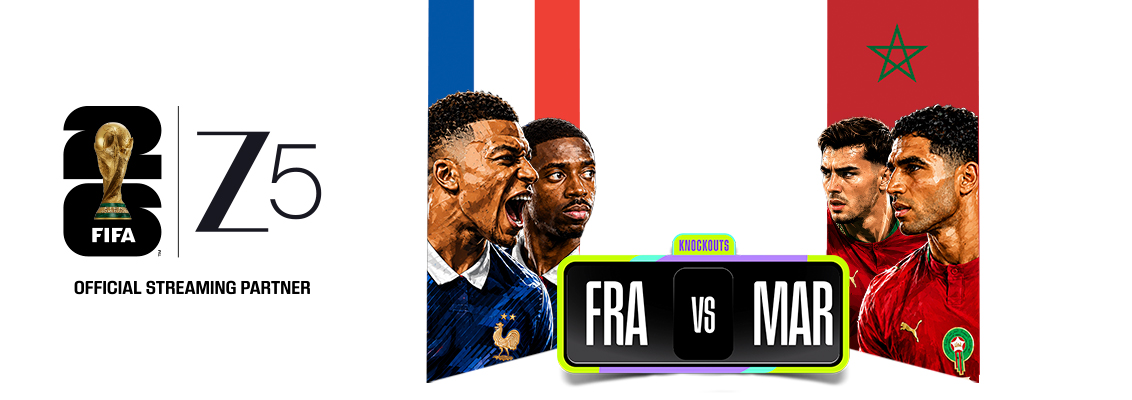
The scoreline reads France 2–0 Morocco. It does not tell the full story. For 60 minutes at the Boston Stadium, Morocco executed one of the most disciplined and tactically intelligent defensive performances in this FIFA World Cup 2026™ — holding France scoreless, surviving a penalty, watching the crossbar deny Digne, and blocking Désiré Doué’s low drive through sheer goalkeeper brilliance. Then Mbappé found the gap, Dembélé doubled it, and the scoreline became what it always looked like it might.
Here is how both sides approached it, what worked, what did not, and what it means going forward.
Watch the full match replay and every remaining FIFA World Cup 2026™ fixture live on ZEE 5. With ZEE 5 FIFA Subscription Quarterly Plan at ₹799.
Morocco’s Defensive Structure — A 4-2-3-1 That Became a 6-3-1
Morocco’s 4-2-3-1 transformed into something far deeper and more compact out of possession. Ayyoub Bouaddi and El Aynaoui in the double pivot dropped consistently to form a defensive midfield screen directly in front of the back four. El Khannouss, Ounahi, and Díaz in the attacking three tracked back tirelessly to form a mid-block that denied France any space between the lines.
In effect, Morocco defended in two banks of three ahead of the back four — making it numerically very difficult for France’s midfield trio to find receivers in the central channel. Michael Olise, operating in the ten role, was specifically marked out of the game for long stretches. The space he normally exploits — between the defensive midfield and the backline — simply did not exist when Morocco were organised.
The full-backs, Hakimi and Salah-Eddine, were cautious. Hakimi, who had pushed aggressively forward in previous matches, stayed closer to the defensive line. This was clearly a deliberate tactical instruction — Deschamps would have identified Morocco’s full-back attacks as a potential weakness to exploit in transition, and Ouahbi closed that avenue by restraining them. Morocco sacrificed their offensive width for defensive security.
The Penalty — And Why the Save Mattered Tactically
Mazraoui’s foul on Mbappé in the 26th minute was a breakdown in Morocco’s collective structure rather than an isolated individual error. France had worked a deep pass from Olise into the channel behind Morocco’s right back, and Mazraoui — caught between tracking Mbappé’s run and holding his line — made a decision too late and too recklessly.
Bounou’s penalty save was not simply a moment of individual brilliance. Tactically, it preserved everything Morocco had constructed in the previous 28 minutes. Had Mbappé scored, Morocco’s mid-block would have needed to open up, their shape would have changed, and France’s ability to exploit transition would have been dramatically enhanced. The save kept Morocco’s game plan intact for another 32 minutes. That is its true significance.
France’s Problem in the First Half — Width Without Penetration
France controlled possession and territory but could not penetrate Morocco’s compact central block. Their wide players — Dembélé on the right and Doué on the left — created width and forced Morocco’s defensive shape to stretch laterally. But stretching a disciplined mid-block horizontally is not the same as breaking through it vertically.
The crossbar from Digne’s long-range effort and Doué’s blocked low drive were products of the same problem: France could generate shots from distance and from wide angles, but they could not get in behind Morocco’s defensive line. Mbappé’s movement was managed by the combination of Mazraoui and Diop holding their shape and Bouaddi’s screening. France’s first-half chances, while numerous, came predominantly from situations that favour the goalkeeper and the defensive structure — long shots, contested headers, and blocked efforts from tight angles.
The 60th Minute Breakthrough — Individual Quality Solving a Collective Problem
What finally broke Morocco was not a tactical adjustment. It was Mbappé. On the hour mark, he received possession on the edge of the box in a position that looked initially containable by Diop. A drop of the shoulder created half a yard. A touch to shift the ball onto his right foot created the angle. The curl into the top far corner was precise enough that Bounou, correctly positioned, could only watch it.
The goal illustrated something important about how elite forwards solve defensive problems that collective play cannot: they do not need the system to create the chance. Mbappé made it himself from what looked like a dead end. Morocco had defended France’s system for 60 minutes. They could not defend that.
The 66th Minute — France’s Depth in Attack
The second goal demonstrated France’s most dangerous tactical quality — the interchangeability of their forward roles. Mbappé, having scored, dropped slightly deeper and drew Morocco’s defensive attention. That shift created space on the right for Dembélé arriving late. Mbappé’s pass was perfectly weighted. Dembélé’s finish — driven low under Bounou — was clinical.
Two different players. Two different roles in the same phase. France are not a team built around one attacking mechanism. They are a team capable of executing multiple different ways to score, often within the same attack. Morocco had no tactical answer to that flexibility.
Morocco’s Attacking Absence — A Calculated Trade-off
Morocco only registered a single shot on target in 90 minutes. In the 83rd minute, Azzedine Ounahi unleashed a powerful strike from the edge of the box off Hakimi’s free kick similar to his first goal against Canada. It was a good attempt, but Mike Maignan parried it away. That was the sum total of their offensive threat. This was not an accident — it was the product of a deliberate tactical decision to protect the defensive structure at all costs and accept that offensive output would be minimal.
Against a lesser side, that trade-off might have produced a different result. Against France, it meant Morocco were always one goal away from needing to fundamentally change their approach — and once Mbappé scored, they did not have the attacking quality to threaten an equaliser. The plan was defensively sound but left no room for error at the other end.
Implications — What This Result Means
France are in the semi-finals for the third consecutive FIFA World Cup™. Their system is functioning exactly as Deschamps intends. The semi-final against either Spain or Belgium will be the most demanding test they have faced in this tournament.
For Morocco, this quarter-final exit ends a campaign that surpassed expectations at every stage. Their defensive organisation was tested by the tournament’s best attacking side and held for an hour. Bounou’s performance will be remembered long after this tournament ends. Their 4-2-3-1 mid-block was one of the most coherent defensive systems on display at the FIFA World Cup 2026™. The foundation for future tournaments is there. The heartbreak of falling short is real — but what Ouahbi’s Morocco built in 2026 deserves recognition.
The FIFA World Cup 2026™ semi-finals are taking shape. Watch every match live in India on ZEE 5.
Disclaimer: Subscription pack prices are subject to change from time to time. Please visit the subscription page for the most up-to-date pricing information.


