





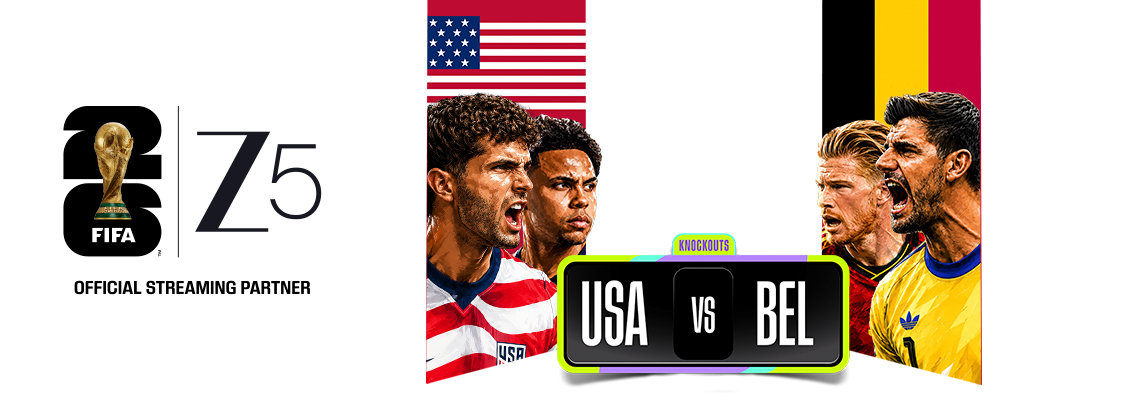
Belgium did not win 4–1 solely because of individual brilliance. Their 4-2-3-1 created structural problems that USA’s 3-5-2 had no answer for — and when individual errors arrived on top of that, the game was gone. The structure collapsed. Belgium needed it all, and they got it.
Catch every remaining FIFA World Cup 2026™ quarter-final live in India on ZEE 5. Subscribe to the ZEE 5 FIFA Subscription Quarterly Plan at ₹799 and don’t miss a single minute.
The Formations: 4-2-3-1 vs 3-5-2
Belgium lined up in a 4-2-3-1. Tielemans and Onana formed the double pivot — a protective base that allowed Raskin to operate freely as the number 10, threading passes between the lines. Trossard on the right and Lukébakio on the left gave Belgium width, while De Ketelaere operated as the central striker — mobile, deceptive, and dangerous in tight spaces as much as in the air.
USA set up in a 3-5-2. Ream, Richards, and Freeman formed the back three. Robinson and Dest pushed high as wing-backs. The plan was to achieve numerical dominance in midfield. Adams played as the pivot, and Tillman and McKennie were supporting the midfield. Balogun and Pulisic played as twin strikers, with the theory being that two forwards pressing Belgium’s back four could generate turnovers and transitions.
The 9th Minute — USA’s Own Doing
The opening goal had nothing to do with Belgium’s tactical superiority. Trossard attempted a cross from the left flank. Alex Freeman blocked it — but rather than clearing his lines, his unconvincing header dropped straight back into the danger zone. Raskin reacted first, drove to the endline, and zipped a low cross into the six-yard box. Ream and Robinson stood static, lost their marks completely, and De Ketelaere split them to tap into an open net from point-blank range. Belgium had done very little. The U.S. had done the rest.
The Shape Mismatch — Wide Players with No Answer
A 3-5-2 defends wide with wing-backs, but when Belgium’s wide forwards — particularly Trossard on the right — received the ball in deeper positions, the U.S. wing-backs were caught between stepping out and holding their line. Step out, and space opens behind. Hold, and Trossard has time on the ball.
USA equalised through Tillman’s deflected free kick in the 31st minute and looked briefly steadied. Fifty-one seconds later, it was 2–1 to Belgium. That quick is how fast this U.S. back three unravelled once the structural pressure resumed.
De Ketelaere — The Wrong Kind of Striker for a Back Three
The 33rd-minute goal was the clearest illustration. Trossard, nominally on the right flank, had drifted across to the left with the ball, creating the angle for a left-footed cross toward the six-yard box. De Ketelaere — having drifted between Ream and Robinson — rose to meet it, winning the header cleanly and driving it into the upper-right corner. Ream, a centre-back by trade, was pulled into the wrong zone and lost his man entirely.
This is what makes a mobile, movement-based striker particularly difficult for a back three to handle. A flat defensive line needs each centre-back to hold their shape and trust their partner to cover the space between them. De Ketelaere’s dropping and re-running movement forced individual decisions, and Ream’s decision was wrong. It will not be the last time that happens to a back three facing a striker of this type in this tournament.
Freese’s Error — The Moment That Closed the Match
At 1–2, the U.S. were still alive. Then came the 57th minute. Matt Freese, attempting to play out from the back, dawdled with the ball outside his penalty area. De Ketelaere pressed hard and won it. Vanaken came across the free ball and calmly slotted it into an empty net with Ream scrambling back. 1–3.
A goalkeeper error of the kind that simply cannot happen at this stage. The 9th-minute goal was a collective defensive failure. This one was a single individual decision in a moment that demanded clarity. Freese had neither. The U.S. never recovered.
Onana Off at 20 — Belgium’s Midfield Still Held
Onana’s forced exit in the 20th minute was the one moment of genuine disruption for Belgium. Losing a double pivot partner early forces recalibration. Tielemans managed it. The Belgian captain covered more ground, sat slightly deeper when needed, and ensured the double pivot function remained intact. Belgium’s midfield control never slipped — a reflection of Tielemans’ quality and Tedesco’s correct selection of a like-for-like replacement.
USA’s Moments — Brief, Brave, Not Enough
The U.S. were not without threat. Tillman’s equaliser was a moment of genuine quality — a free kick deflected in off a Belgian head in the wall, but struck with enough conviction to cause it. McKennie and Tillman pressed aggressively throughout but could not produce any major chance.
A 3-5-2 demands high defensive discipline and well-timed pressing. When the errors came — and they came at the worst possible moments — there was no cover deep enough to absorb them.
The FIFA World Cup 2026™ quarter-finals are here. Watch them all live in India on ZEE 5 — the exclusive streaming home of the tournament.
Disclaimer: Subscription pack prices are subject to change from time to time. Please visit the subscription page for the most up-to-date pricing information.


