





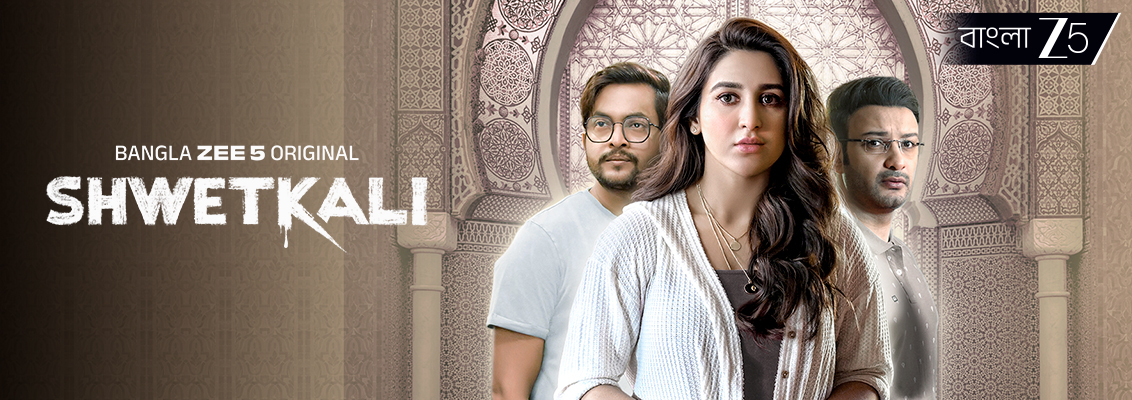
From gripping Bengali thrillers like Shwetkali to your favourite Bengali shows, Zee 5 has plenty of stories you wouldn’t want to miss! And why pay full price when you can get the Zee 5 Super Family Fest All Access + Sports Pack at 50% OFF? But hurry, this festive deal disappears after 11th November! Grab it now before you miss out on your favourite entertainment at half the price!

The final beat of the dhak fades, the vermilion smears on the sindoor khela dry, and the goddess returns to her celestial home. For most of India, the departure of Durga Puja marks the quiet end of the festive frenzy. But in Bengal, the silence is short-lived. As the autumn air grows heavy and the shadows stretch longer, the state slips seamlessly from vibrant celebration into a realm of deep, atmospheric shadows.
This is the eerie twilight zone between Bijoya Dashami and Bhoot Chaturdashi—a fortnight where the veil between the living and the dead feels razor-thin, and ancient folklores wake up from their long slumber.
The Transition from Joy to the Macabre
Bengali festivities are intensely emotional. The joy of Mahashtami and Navami carries an underlying, bittersweet ache of departure. When Dashami arrives, the immersion of the idol leaves a tangible vacuum in every Bengali household. Yet, cultural traditions dictate that life doesn’t just return to normal; instead, the spiritual landscape shifts dramatically.
During the days leading up to Kali Puja and Diwali, the focus turns inward and toward the esoteric. Families prepare for Bhoot Chaturdashi, the fourteenth lunar day of the waning moon in the month of Kartika. According to rural folklore, this is the night when the spirits of fourteen generations of ancestors visit their earthly homes. To guide them and to ward off malevolent entities, households light fourteen earthen lamps (chouddo prodeep) in every dark corner of the house and consume fourteen specific leafy greens (chouddo shak).
It is a fascinating cultural duality: one week you are celebrating divine feminine power in broad daylight, and the next, you are whispering ghost stories in the flickering glow of clay lamps. This unique blend of devotion, regional mythology, and ancestral reverence creates the ultimate psychological breeding ground for horror, mystery, and dark folklore.
Enter Shwetkali 2: Merging Modern OTT Thrills with Ancient Myth
Capturing this exact atmospheric transition from festive cheer to ancestral dread is no small feat, but the screen adaptation has found its home in the upcoming Bengali web series, Shwetkali 2. The web series leans heavily into the dark, hidden undercurrents of Bengal’s festive and ritualistic heritage.
Directed by Sani Ghosh Ray and produced by Acropoliis Entertainment Pvt. Ltd., this seven-episode mythological horror-thriller web series is tailor-made for binge-watching during the spooky season. The narrative follows Urvi (played by Oindrila Sen), a pregnant doctor who visits the isolated, atmospheric Roy Chowdhury estate in the fictional North Bengal village of Megh-Jhuri. Her timing couldn’t be more ominous: she arrives right in the middle of the annual Guha Kali festival.
What begins as a traditional rural visit quickly unravels into a nightmare involving a possessed bride, a string of inexplicable snakebite deaths, and a sinister, centuries-old curse buried deep within local religious traditions. Alongside Oindrila Sen, the ensemble cast featuring Ridhima Ghosh, Surangana Bandyopadhyay, Anindya Chatterjee, Saptarshi Maulik, Rajdeep Gupta, and Geetashree Roy brings a chilling intensity to the screen.
Why Bengal’s Dark Folklore Resonates Today
What makes stories like Shwetkali 2 click with audiences isn’t just the jump scares; it is the deep-rooted cultural authenticity. Bengal’s folklore is rarely about mindless monsters. Instead, it deals with bhoy (fear) intertwined with devotion, unresolved family sins, generational curses, and the fierce, unyielding wrath of forgotten deities.
When you combine the historical weight of ancestral worship on Bhoot Chaturdashi with the intense, localized traditions of remote North Bengal villages, you get a storytelling canvas that feels rich, claustrophobic, and deeply immersive. The fictional village of Megh-Jhuri acts as a character in its own right where every rustling bamboo grove and flickering oil lamp hides a secret waiting to be exposed.
Wrapping Up the Festive Nightmares
As the festive lights of Diwali and Kali Puja fade and the chill of late autumn finally settles in, Bengal’s cultural calendar reminds us that light cannot exist without darkness. The journey from the tearful hugs of Bijoya Dashami to the solitary vigil of Bhoot Chaturdashi is a reminder of our connection to the past, both bright and terrifying.
If you are looking to extend the eerie thrill of the season long after the pujo pandals have been dismantled, diving into the murky, cursed waters of Megh-Jhuri with Shwetkali 2 might just be the perfect way to spend a chilly autumn night.
Will you be tuning in to uncover the dark secrets of the Guha Kali festival this season?


