





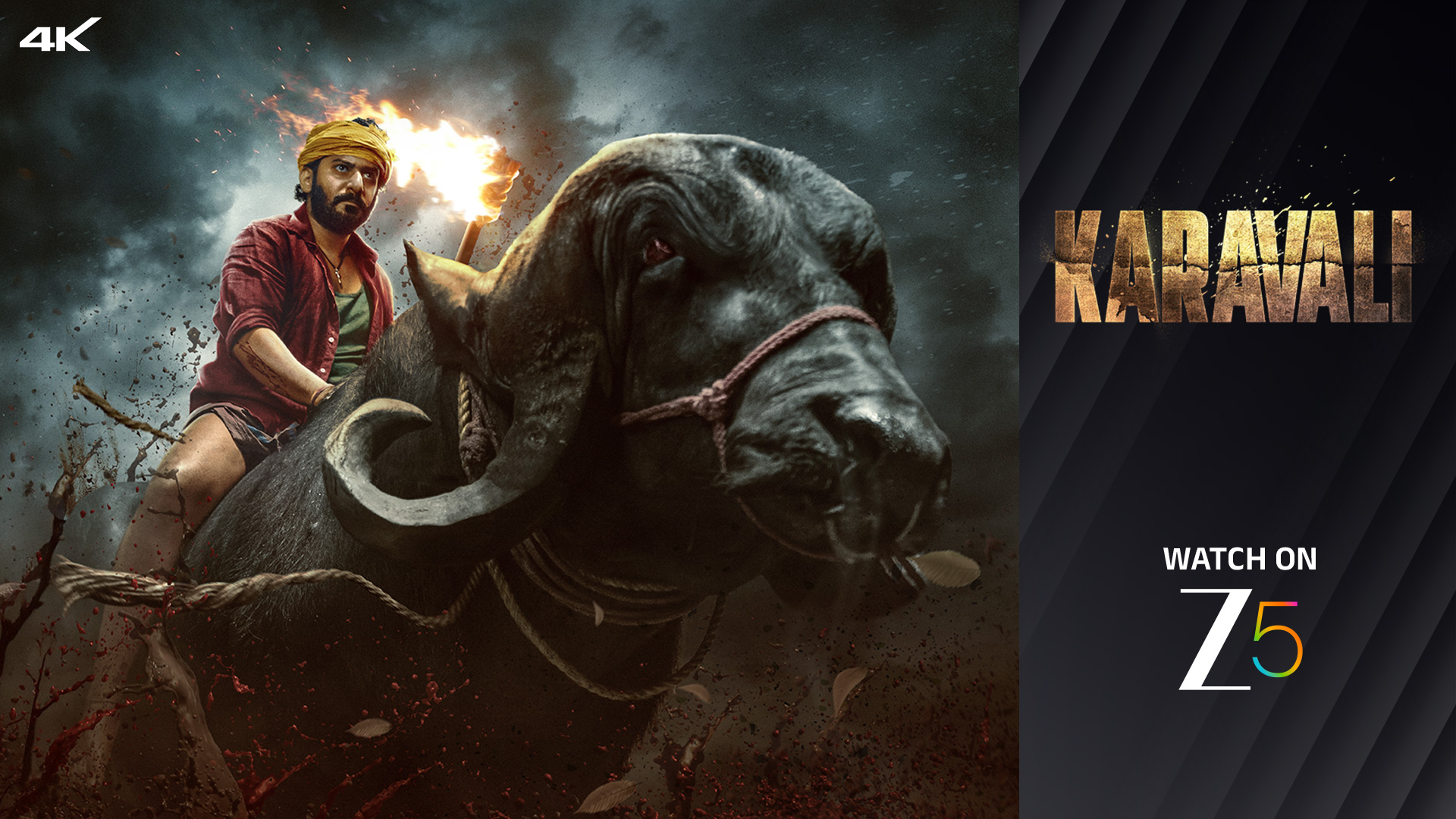
Some films surprise you with their story. Others pull you in with the world they create. Karavali belongs firmly to the second group.
Set against the Kambala tracks of coastal Karnataka, Karavali stands out for its cinematography, music, cultural detailing and performances. Although the revenge narrative follows a familiar path, the technical execution makes it visually compelling.
Karavali Builds a World You Can Almost Feel
Coastal Karnataka never feels like decorative scenery in the film.
Director Gurudatha Ganiga creates a lived-in world of race tracks, village gatherings, buffalo sheds and deeply held traditions. Kambala becomes part of the characters’ identities rather than merely a visual attraction.
The film is most absorbing when it explores the effort, pride and emotional investment surrounding the traditional buffalo race. These details give it a strong sense of place.
Abhimanyu Sadanandan’s Camera Steps Into the Mud
Cinematographer Abhimanyu Sadanandan brings the audience close to the buffaloes, runners, flying water and restless crowds. The racing sequences feel immediate because the visuals capture both speed and physical effort.
Wide coastal landscapes provide scale, while tighter frames intensify the personal conflicts. Even when the story becomes predictable, the visual treatment remains striking.
Sachin Basrur’s Music Gives the Film Its Pulse
Sachin Basrur’s background score adds urgency to the racing and action sequences while preserving the earthy mood of the setting. The percussion and rising rhythms make Kambala feel like a celebration, competition and emotional battleground.
The sound design strengthens these moments through the sounds of hooves, splashing water and cheering crowds.
The Revenge Drama Follows a Familiar Track
For a film set in such a distinctive world, the central revenge structure feels familiar.
The narrative combines pride, old wounds, power struggles and relationships shaped by the past. Several turns are easy to anticipate, and the screenplay relies on established action-drama patterns instead of taking the Kambala setting in a more unexpected direction.
This predictability reduces the tension, even though the presentation remains engaging.
Strong Craft Cannot Always Hide the Uneven Pacing
Karavali occasionally loses momentum between its strongest moments.
The Kambala sequences are energetic, and the quieter scenes give the actors room to perform. However, some conflicts develop too quickly, while certain emotional ideas are repeated.
Editor Pratheek Shetty gives the major set pieces clarity, but the connecting sections do not always maintain the same intensity.
Mithra and Raj B. Shetty Leave the Strongest Impact
Mithra delivers a restrained and heartfelt performance as Mahabala. His connection with the buffaloes and Kambala feels natural, giving the film emotional depth beyond its louder conflicts.
Raj B. Shetty appears as Mahaveera in an extended cameo, but his presence makes each appearance memorable. The character carries authority without relying entirely on loud dialogue or action.
Prajwal Devaraj Brings Sincerity to Dhananjaya
Prajwal Devaraj plays Dhananjaya, or Dhana, with measured seriousness. His physical transformation suits the demanding Kambala portions, and he is particularly effective in quieter moments.
The dubbed voice occasionally creates distance between the actor and the emotion of the scene, but the performance remains sincere and grounded in the film’s cultural setting.
The Supporting Cast Strengthens the Coastal World
Ramesh Indira plays Adishesha with controlled authority, while Sampada Hulivana brings calmness and empathy as a veterinary doctor. Govinde Gowda and K.S. Sridhar add authenticity to the village setting.
Sushmitha Bhat makes an impression as Bhumi, although the female characters could have received more narrative space. The supporting performances work well, but the writing limits some of their development.
Does Karavali’s Technical Craft Outrun Its Predictable Story
Yes, although not without flaws.
Karavali succeeds as a technically polished film about coastal Karnataka, Kambala and the relationship between people, animals and tradition. Its cinematography, score, sound design and performances create several memorable moments.
The revenge drama is less layered and easier to predict than the cultural world surrounding it. Still, the film deserves attention for its ambition, regional authenticity and focus on Kambala.
Watch Karavali on Zee 5
If you enjoy culturally rooted action dramas with striking visuals and strong performances, watch the Karavali movie online on Zee 5. You can also watch Kantara, another gripping Kannada action drama rooted in coastal traditions, folklore and powerful performances.
Frequently Asked Questions About Karavali
Q1. Is Karavali Based on a True Story?
Ans. Karavali is a fictional narrative rooted in the culture and traditions surrounding Kambala.
Q2. Who Wrote the Story of Karavali?
Ans. Chandrashekar Bandiyappa wrote the original story, while Gurudatha Ganiga and his team developed the screenplay.
Q3. What Does the Title ‘Karavali’ Mean?
Ans. “Karavali” refers to the coastal belt of Karnataka, where the film is set.
Q4. Was Karavali Shot at a Real Kambala Track?
Ans. Yes. Parts of the film were shot at the historic Katapadi Kambala track in coastal Karnataka.
Q5. What Are the Main Karavali Movie Songs?
Ans. The soundtrack includes “Muddu Gumma,” “Baa Karavalige” and “Rage of Kambala.”


